
California restaurant employers facing an employee lawsuit, demand letter, or agency complaint may find that ordinary scheduling decisions become central issues in a wrongful termination or retaliation claim. Reduced shifts, schedule changes, discipline, removal from the schedule, and termination may be examined differently when an employee alleges that the decision followed a wage complaint, harassment report, discrimination concern, job-protected medical leave issue, reasonable accommodation request, whistleblower allegation, or other protected activity.
For small restaurants, specifically those with five or more employees, the dispute can affect more than the legal filing. Under the California Family Rights Act (CFRA), updated regulations now extend job-protected leave requirements to smaller employers, meaning even modest scheduling changes can be examined under the lens of retaliation for taking a protected medical leave.
When Restaurant Scheduling Decisions Become Employment Litigation
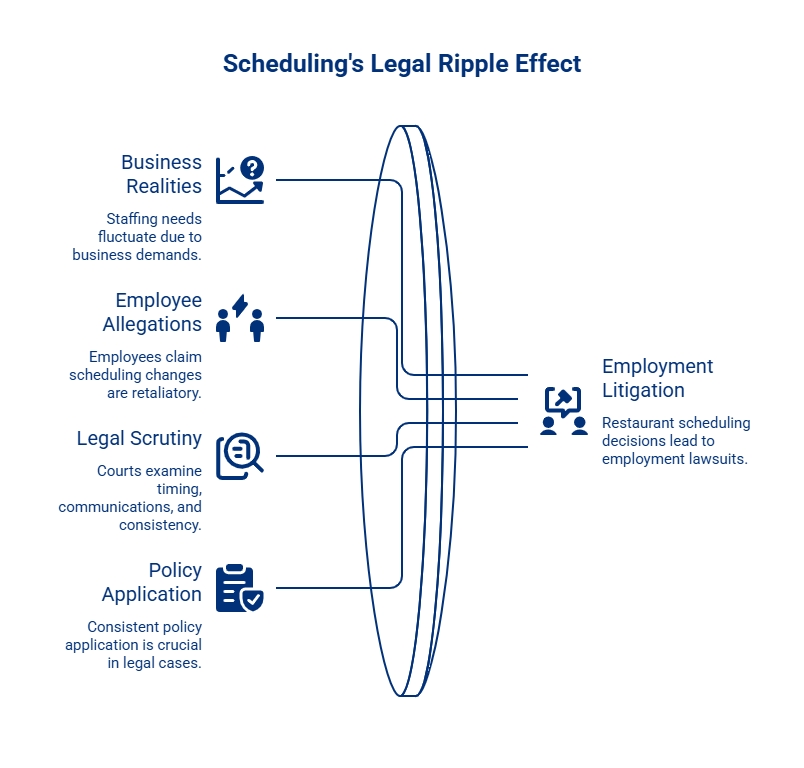
Restaurant schedules often reflect business realities. Staffing needs may change because of customer volume, employee availability, attendance problems, shift coverage, performance concerns, or manager judgment. In a lawsuit, however, the employee may allege that a reduced schedule or unfavorable shift assignment was not merely operational. The complaint may claim that the restaurant reduced hours, issued discipline, or ended employment because the employee engaged in protected activity.
That allegation changes the focus of the dispute. The issue may no longer be limited to whether the restaurant needed fewer shifts filled. A judge, jury, or trier of fact may consider timing, manager communications, consistency, prior discipline, payroll records, timekeeping records, and how similarly situated employees were treated. The trier of fact may also consider whether the restaurant applied established policies consistently across comparable employment decisions.
For restaurant owners searching for wrongful termination defense lawyers for employers in LA, the practical concern is usually not abstract legal theory. The concern is that a routine staffing decision has been reframed as evidence of unlawful motivation.
Why Reduced Hours and Schedule Changes Can Matter in a Claim
A reduction in hours may be alleged as a legally significant employment decision when the employee claims the change affected pay, schedule stability, job status, or working conditions. A schedule change may also become significant when it occurs close in time to a wage complaint, a harassment report, a medical condition, a disability-related concern, or participation in an agency proceeding.
In active litigation, ordinary business records may be examined considering the plaintiff’s allegations, the restaurant’s stated legitimate business reason, and the timing of the employment decision. Posted schedules, timekeeping data, payroll records, point-of-sale staffing information, manager notes, emails, text messages, discipline records, and contemporaneous documentation may all become part of the broader factual record, especially when consistency is disputed.
In closely held restaurants, direct owner involvement and informal communication may be ordinary business realities. Once litigation begins, however, those same realities can receive close scrutiny. A brief manager text, a rushed scheduling note, or inconsistent explanation may become part of the employee’s narrative. That does not mean the employee’s allegations are valid. It means the litigation may examine whether the restaurant’s stated legitimate business reason is supported by the broader record.
Alleged Retaliation After Employee Complaints or Workplace Conflicts
Retaliation allegations may arise when an employee claims that reduced hours, discipline, or termination followed protected activity. Protected activity may include, among other things, complaints about wages, meal and rest breaks, harassment, discrimination, workplace safety, job-protected medical leave, reasonable accommodation, or suspected legal violations.
The underlying complaint may be disputed, but the retaliation claim may focus heavily on the employer’s response. The employee may attempt to establish a causal connection between the protected activity and the later employment decision. Retaliation claims may also place consistency, contemporaneous explanations, and treatment of similarly situated employees under scrutiny.
The restaurant may view the same decision as the result of attendance problems, shift coverage needs, customer complaints, or performance concerns. That tension often makes retaliation claims fact-intensive and document-heavy.
Employers facing these allegations may look for unlawful workplace retaliation lawyers for employers in LA because retaliation claims can expand quickly and overlap with other legal theories.
Wrongful Termination Claims After Scheduling and Performance Disputes
Wrongful termination claims involving restaurants often grow out of familiar workplace events. The dispute may involve lateness, no-shows, refusal to work assigned shifts, customer complaints, conflict with a supervisor, cash-handling concerns, performance issues, or a breakdown in trust. The employee may allege that those stated reasons were pretext for unlawful motivation.
From an employer-defense perspective, wrongful termination litigation often examines more than the final separation decision. The litigation may scrutinize the restaurant’s communications, discipline history, shift assignments, performance concerns, and treatment of similarly situated employees. In that setting, defensible employment decisions often depend on whether the stated reasons align with the factual record and consistent treatment of comparable employees.
A termination that appeared straightforward at the time may become contested when the employee connects it to a wage complaint, harassment report, medical condition, whistleblower allegation, or other legally significant event.
California restaurant owners may feel blindsided when a former employee characterizes a scheduling dispute as retaliation or wrongful termination. That reaction is understandable. The legal claim still depends on the allegations, the available evidence, and the procedural posture of the matter.
Why Restaurant Employment Claims Can Expand Quickly
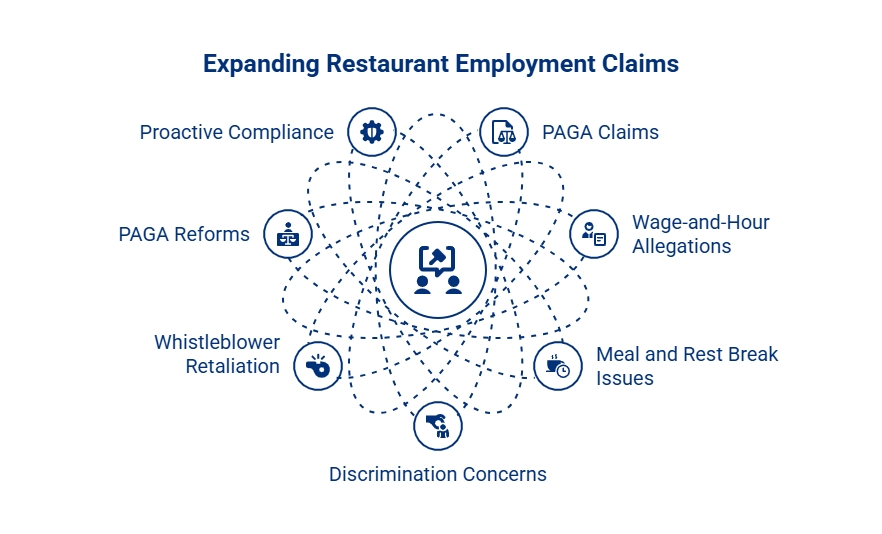
A lawsuit that begins with reduced hours or termination may not remain limited to that issue. The complaint may also assert representative claims under the Private Attorneys General Act (PAGA), alongside wage-and-hour allegations, missed meal or rest break claims, and discrimination concerns. However, following the 2024 PAGA reforms (SB 92 and AB 2288), employers who proactively conduct payroll audits and take ‘all reasonable steps’ to comply with the Labor Code can now significantly cap their penalty exposure—reducing potential fines by up to 85% in certain instances. These overlapping theories make it essential to evaluate the entire record for compliance before a claim is even filed.
These overlapping theories can increase complexity for a restaurant because each claim may place different records, witnesses, and management decisions at issue. A scheduling dispute may connect to alleged unpaid wages. A termination claim may connect to a prior harassment complaint. A disability-related dispute may involve allegations concerning reasonable accommodation or failure to engage in the interactive process.
Restaurants facing payroll-related allegations may need employment litigation counsel familiar with wage and hour defense for employers in LA and related claims involving meal and rest break issues. When allegations involve suspected legal violations, reporting activity, or refusal to participate in allegedly unlawful conduct, whistleblower retaliation claims may also become part of the dispute.
Why Procedural Posture Can Affect Risk in Restaurant Employment Claims
Employment lawsuits, demand letters, agency complaints, and regulatory notices may involve strict procedural obligations. When procedural obligations are mishandled, consequences may include default judgment, sanctions, or expanded exposure. The specific requirements depend on the claim, forum, and procedural posture.
Active litigation may also involve evidence-preservation obligations, privilege issues, work-product concerns, and communications that require careful handling. For a small restaurant without in-house litigation counsel, these issues can consume owner bandwidth and create operational strain while the restaurant continues its business operations of serving customers.
Why Litigation-Focused Defense Counsel Matters for Small Restaurants
Small restaurant employers often need counsel who understands both employment litigation and the practical realities of running a closely held business. A claim can affect scheduling records, payroll systems, employee witnesses, manager credibility, reputation, and daily operations.
Employment defense counsel can evaluate the specific allegations, procedural posture, and litigation risks that cannot be assessed from general information alone. Akopyan Law Firm, A.P.C. represents employers in employment disputes with attention to litigation exposure, efficiency, and business disruption. Restaurant employers facing active or threatened retaliation, or wrongful termination claims may contact Akopyan Law Firm, A.P.C. to discuss employment defense representation.
Disclaimer:
This content is for informational purposes only. Laws, definitions, and deadlines change. Verify current requirements through official California sources. This content is not legal advice. No attorney-client relationship is formed through this content. Please consult a qualified attorney in your jurisdiction for legal advice specific to your situation.
Protect Your Business | The Akopyan Law Firm, A.P.C. | Top Gun Employment Lawyers
Have you been sued by an employee? Are you overwhelmed by the complexities of employment law? If so, give us a call. The Akopyan Law Firm, A.P.C. assists small business owners throughout Southern California. Our seasoned employment defense lawyers stand ready to help employers quickly and efficiently resolve employment disputes. We are ready to aggressively and skillfully defend against any employment case, but understand that in most situations avoiding the expense of litigation is in the client’s best interest.
Take the First Step Protecting Your Future: Call us today to speak with one of our experienced employment lawyers.
Contact Us Today:
- Phone: (818) 509-9975
- Office Locations in California: Los Angeles, Bakersfield, Costa Mesa, Temecula, Rancho Cucamonga, Oxnard, Culver City, and San Diego.