

📌 Key Takeaways
Performance-management disputes may become wrongful termination exposure when the employer’s explanation appears inconsistent, newly intensified, or vulnerable to a pretext argument in litigation.
- Consistency Drives Defensibility: A restaurant employer’s stated performance reason may receive close scrutiny when discipline, coaching, and internal communications do not align over time.
- Timing Can Increase Exposure: Termination near complaints, leave-related issues, or other protected activity may support arguments about retaliation, causation, and pretext.
- Informal Practices Create Risk: Texts, verbal coaching, and shifting supervisor accounts may complicate how managers explain performance concerns in a later dispute.
- Comparators Matter Quickly: Allegations involving similarly situated employees may gain force when enforcement appears uneven across shifts, managers, or locations.
- One Dispute Can Expand: A performance-based discharge may overlap with wrongful termination, retaliation, or whistleblower claims when the surrounding facts support multiple theories.
In these cases, the performance narrative often becomes the case.
California restaurant owners facing active employment disputes will gain a clearer view of how performance issues may shape litigation exposure, guiding them into the dispute-specific analysis that follows.
~ ~ ~ ~ ~ ~ ~ ~ ~ ~ ~ ~ ~ ~ ~ ~ ~ ~
Under California law, generally, performance-management issues may become central to a wrongful termination lawsuit because the dispute often reaches well beyond the final discharge decision. In many cases, the plaintiff does not challenge only the discharge decision under a common-law ‘wrongful termination in violation of public policy’ (or Tameny) theory. The plaintiff may also challenge the employer’s larger performance narrative—including discipline, attendance history, and internal communications—to demonstrate that the stated reason was a pretext for an underlying illegal motive, such as discrimination or retaliation prohibited by the Fair Employment and Housing Act (FEHA). In that setting, the dispute centers on whether the employer’s stated reason remains consistent, or whether the plaintiff can prove ‘the employer’s proffered explanation is unworthy of credence.
In this context, restaurant employers may face especially fact-intensive scrutiny. Restaurant operations often involve owner oversight, shift managers, operating managers, and multiple supervisors who communicate quickly and sometimes informally. Performance concerns may be discussed in texts, verbal coaching, shift-level conversations, or manager reports before those same concerns are later described more formally in a dispute. Depending on the facts, that structure may create disagreement about who reported the concern, when management viewed the issue as serious, whether expectations were applied uniformly, and whether the final explanation matches the earlier record.
Why Performance-Management Facts May Shape the Entire Dispute
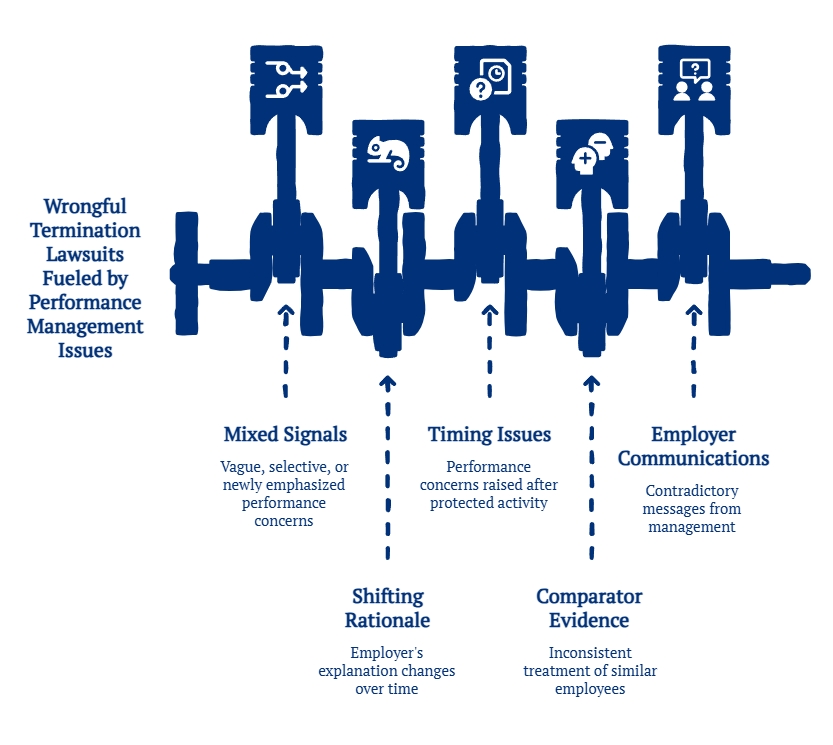
A wrongful termination claim may expand into a broader challenge to the employer’s account of the employment relationship. Performance evaluations, disciplinary history, attendance issues, guest-service complaints, productivity concerns, and policy-compliance allegations may all become legally significant because the plaintiff may use those facts to test motive, causation, and consistency. In many disputes, the legal question is not limited to whether management was dissatisfied. The dispute may instead center on whether the employer’s performance-based explanation remained stable over time or whether the plaintiff alleges that the rationale shifted as the conflict developed.
That issue may become more complicated when the record contains mixed signals. A plaintiff may allege that performance concerns were vague, selectively enforced, newly emphasized, or raised only after protected activity or workplace conflict. An employer may argue that the decision was grounded in legitimate business concerns. Even so, the dispute may turn on how those competing narratives relate to timing, comparator evidence, and the employer’s own communications.
Which Restaurant-Workplace Facts Often Receive the Closest Scrutiny
In restaurant settings, certain categories of performance-related facts often receive close attention in litigation. Attendance and punctuality issues may matter because they are commonly cited as business reasons for discipline or discharge. Guest-service complaints and productivity concerns may matter because they are often subjective enough to invite disagreement about seriousness and consistency. Coaching history may matter because the plaintiff may allege that management tolerated the conduct until another conflict arose. Internal messages and supervisor discussions may matter because they may be cited to support or challenge the employer’s explanation.
At the same time, comparative treatment often becomes a central feature of the dispute. A plaintiff may allege that other employees engaged in similar conduct without similar discipline, or that management enforced expectations unevenly across shifts, locations, or supervisors. In that setting, the trier of fact may consider not only the asserted performance issue, but also whether the employer’s explanation appears consistent across employees and across time.
Why Pretext, Causation, and Consistency Often Dominate Litigation
In many California employment disputes, the plaintiff may attempt to show that the stated performance reason was not the true reason for the termination. That allegation may be framed through claims of shifting explanations, sudden escalation, selective enforcement, or an unusual change in how management described the employee’s performance. The plaintiff may also argue that the discharge followed protected activity closely enough to support an inference of retaliation or another unlawful motive.
For that reason, performance management may become central not because every performance dispute creates liability, but because the employer’s performance narrative may become the vehicle through which the plaintiff argues pretext and causation. A termination that management viewed as performance-based may later be portrayed in pleadings as a reaction to conflict, complaint activity, leave-related issues, or protected opposition to workplace conduct. Whether that portrayal succeeds depends on the facts, the governing legal framework, and the evidence developed in the dispute.
Why Restaurant Operations Can Intensify Credibility Disputes
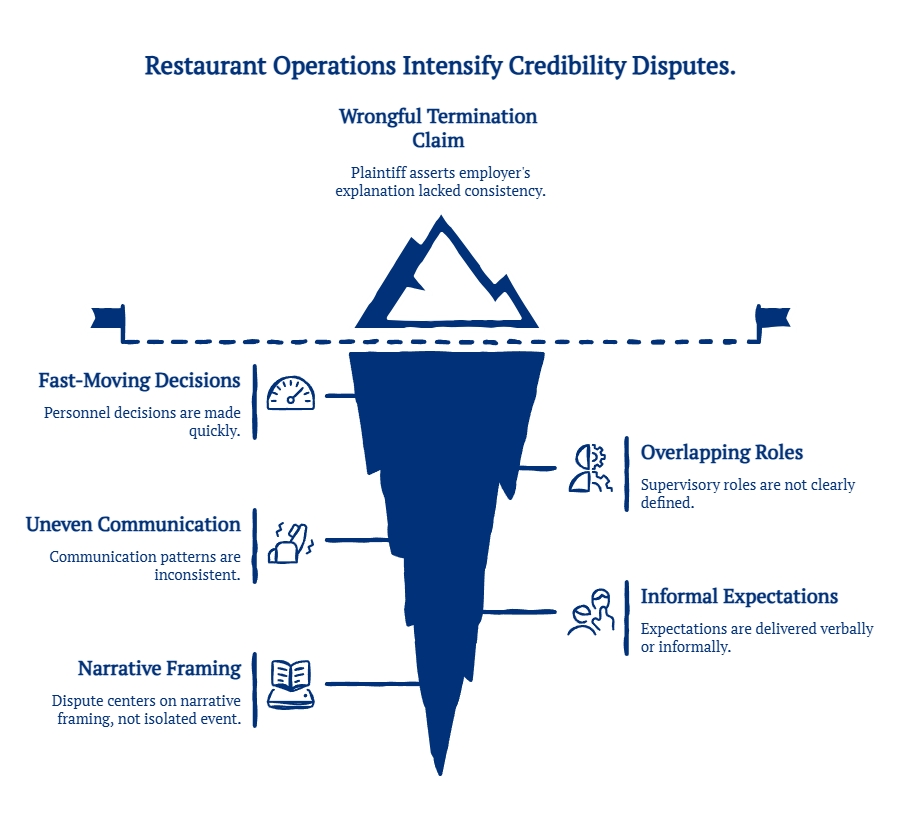
Restaurant workplaces often generate fast-moving personnel decisions, overlapping supervisory roles, and uneven communication patterns. Those characteristics are common litigation patterns rather than universal facts, but they may intensify credibility disputes when a wrongful termination claim is asserted. If one manager describes the issue as attendance-related, another describes it as attitude-related, and a third emphasizes customer-service problems, the plaintiff may argue that the employer’s explanation lacked consistency from the outset. If expectations were delivered verbally or informally, the dispute may become even more centered on who said what, when, and why.
In practice, that kind of record may produce a dispute about narrative framing rather than a dispute about one isolated event. The plaintiff may rely on chronology, internal communications, and comparative treatment to argue that the stated rationale was pretextual. The employer may rely on the broader history of performance concerns. The legal significance of those competing positions often depends on how the full employment story is presented and challenged.
How a Performance-Based Termination Dispute May Expand into Other Claims
A performance-centered dispute may also overlap with specific statutory protections. Depending on the facts, the same allegations may be paired with a Tameny public policy theory, an unlawful retaliation claim under FEHA, or a whistleblower retaliation claim under California Labor Code section 1102.5. The latter is particularly significant for restaurant owners, as it protects employees who disclose information to a supervisor or government agency regarding what they reasonably believe is a violation of a local, state, or federal rule or regulation. In some disputes, the plaintiff may allege that performance concerns were used to conceal retaliation for protected activity. In other disputes, the plaintiff may allege overlap with discrimination, harassment, leave-related, or wage-and-hour issues where the surrounding facts support that theory.
As a result, the case may become more complex than a single disagreement about job performance. The dispute may involve multiple legal theories, broader evidentiary scrutiny, and greater pressure on business owners, operators, and company leadership.
Why These Cases Often Create Immediate Pressure for Restaurant Employers
For small and closely held restaurant businesses, a performance-centered wrongful termination dispute may create immediate operational and legal pressure. Leadership distraction, reputational strain, witness complications, and the burden of defending the employer’s explanation may all become part of the problem. In many disputes, the pressure arises because the claim develops into a fact-intensive challenge to motive, chronology, and consistency rather than a narrow review of a single termination decision.
Disclaimer:
This content is for informational purposes only. Laws, definitions, and deadlines change. Verify current requirements through official California sources. This content is not legal advice. No attorney-client relationship is formed through this content. Please consult a qualified attorney in your jurisdiction for legal advice specific to your situation.
Protect Your Business | The Akopyan Law Firm, A.P.C. | Top Gun Employment Lawyers
Have you been sued by an employee? Are you overwhelmed by the complexities of employment law? If so, give us a call. The Akopyan Law Firm, A.P.C. assists small business owners throughout Southern California. Our seasoned employment defense lawyers stand ready to help employers quickly and efficiently resolve employment disputes. We are ready to aggressively and skillfully defend against any employment case, but understand that in most situations avoiding the expense of litigation is in the client’s best interest.
Take the First Step Protecting Your Future: Call us today to speak with one of our experienced employment lawyers.
Contact Us Today:
- Phone: (818) 509-9975
- Office Locations in California: Los Angeles, Bakersfield, Costa Mesa, Temecula, Rancho Cucamonga, Oxnard, Culver City, and San Diego.