
Family-owned Southern California businesses may face broader exposure when an employee’s meal or rest break complaint is followed by discipline, reduced hours, or termination.
- Break Complaints May Be Protected: Even an informal text or comment about a missed, delayed, shortened, or interrupted break may constitute protected activity under California law.
- Ninety Days May Matter: An adverse action within 90 days of specified protected activity may trigger a rebuttable presumption supporting an employee’s retaliation claim.
- Documentation Shapes the Dispute: Contemporaneous records may clarify management knowledge, policy consistency, comparable treatment, and the employer’s stated reason for the employment decision.
- Concentrated Authority Increases Scrutiny: When one owner handles complaints, payroll, discipline, and termination, that decision-maker’s communications and explanations may become central evidence.
- One Decision May Multiply Claims: A termination following a break complaint may produce wage, retaliation, wrongful termination, overtime, off-the-clock, and related payroll allegations.
For family-owned employers, consistent policies, complete records, and documented reasons may strengthen the factual record before a sensitive employment decision becomes litigation.
A routine break complaint may become a broader dispute when timing, decision-making, and inconsistent records converge.
A meal or rest break complaint may develop into a broader employment dispute when a California employee later alleges that discipline, reduced hours, or termination resulted from the complaint. Timing alone does not prove retaliation or wrongful termination. It may, however, connect the underlying wage issue to questions about protected activity, causation, management knowledge, policy consistency, and the employer’s stated reason for the decision.
California generally requires employers to provide a duty-free meal period of at least 30 minutes when a nonexempt employee works more than five hours, and a second meal period when the employee works more than 10 hours. Nonexempt employees are also generally entitled to a paid 10-minute rest period for every four hours worked, or major fraction thereof. When an employer fails to provide a compliant meal or rest period, the employee may be entitled to one additional hour of pay at the employee’s regular rate of compensation—which the California Supreme Court has ruled must include all non-discretionary bonuses and incentive pay, not just the base hourly rate—for each workday on which a violation occurred. These requirements create a framework in which even routine scheduling decisions can become the basis for a wage claim, and, if an adverse employment action follows, a broader dispute.
A Break Complaint May Constitute Protected Activity
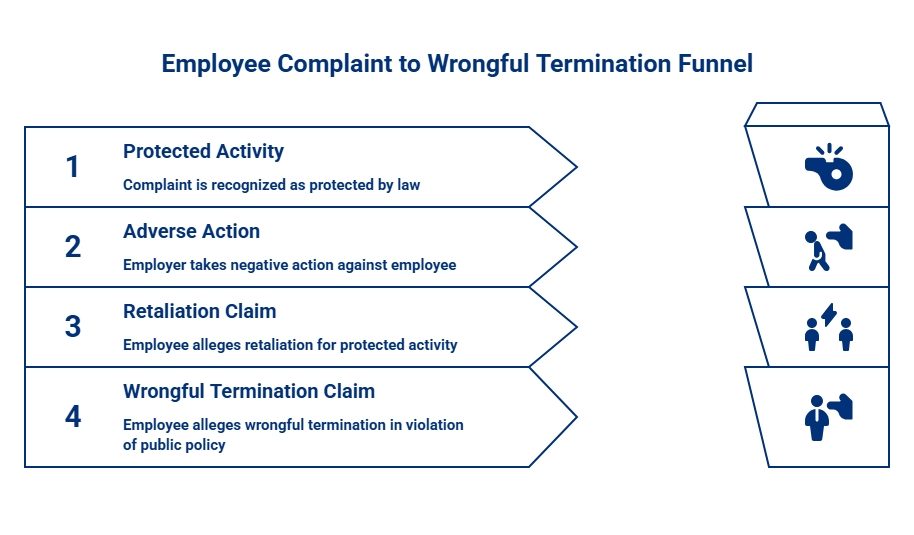
California law protects certain employee complaints about wages and working conditions. California Labor Code section 98.6 prohibits specified adverse action against an employee because the employee engaged in conduct protected by that statute, including making a bona fide complaint concerning rights under the Labor Commissioner’s jurisdiction. A complaint does not need to be a formal written grievance to trigger protections; a casual text message to a manager about a missed lunch or an offhand comment about a shortened rest break can qualify as protected activity.
A complaint about allegedly missed, delayed, shortened, or interrupted breaks may therefore implicate more than a meal and rest break dispute. If a contested employment action follows, the employee may also assert retaliation or wrongful termination.
These theories remain legally distinct. Statutory retaliation depends on the requirements of the applicable statute. Wrongful termination in violation of public policy is a California common-law claim that generally arises when an employee alleges that a discharge violated a public policy established by a statute or the California Constitution.
California’s 90-Day Rebuttable Presumption
Senate Bill 497, which took effect on January 1, 2024, amended several California Labor Code provisions, including section 98.6, to create a rebuttable presumption in favor of an employee’s retaliation claim when an employer takes action prohibited by the statute within 90 days after the employee engages in protected activity specified in that section. SB 497 also authorized a civil penalty of up to $10,000 per employee for each violation, payable to the affected employee.
A dispute often hinges on three questions: did the employee engage in protected activity, did the employer take prohibited adverse action, and did an independent reason actually cause the termination? The employee may allege that the asserted explanation was pretextual. The employer may rely on evidence concerning performance, attendance, misconduct, restructuring, or another operational basis.
Temporal proximity can contribute to an inference of causation and, when statutory conditions exist, trigger rebuttable presumption.
The Evidentiary Record May Extend Beyond Timekeeping
It is important to remember that under California law, an employee generally has up to three years to file a claim for unpaid wages or meal and rest break premiums, meaning a complaint today could trigger scrutiny of records from years past. When a basic payroll disagreement escalates into a termination claim, it places a wider range of evidence under examination, including:
- Timekeeping data, work schedules, and payroll records related to the original break allegations.
- Emails, text messages, and notes showing when managers learned of the complaint.
- Attendance records, performance evaluations, disciplinary documents, and customer communications.
- Workplace policies and evidence concerning their application to employees in comparable circumstances.
- Accounts from owners, supervisors, payroll personnel, and other witnesses involved in the events.
These materials may support, contradict, or add context to the parties’ competing explanations. Contemporaneous documentation does not carry a predetermined legal weight; its significance depends on authenticity, completeness, consistency, and the governing legal standards.
Illustrative Example: Attendance Policy and Termination
An hourly employee at a family-owned service company reports that several meal periods were allegedly delayed during a busy month. Several weeks later, the company terminates the employee for repeated attendance violations. The employee alleges retaliation, while the company maintains that attendance problems caused the separation.
The company’s written policy calls for progressive discipline, but the available records show uncertainty about whether every listed disciplinary stage occurred. Other employees with attendance problems may also have received different treatment. These variables often determine whether the stated reason for discharge appears consistent with company policy, prior practice, and the broader employment record.
Family-Owned Management Structures Can Concentrate the Dispute
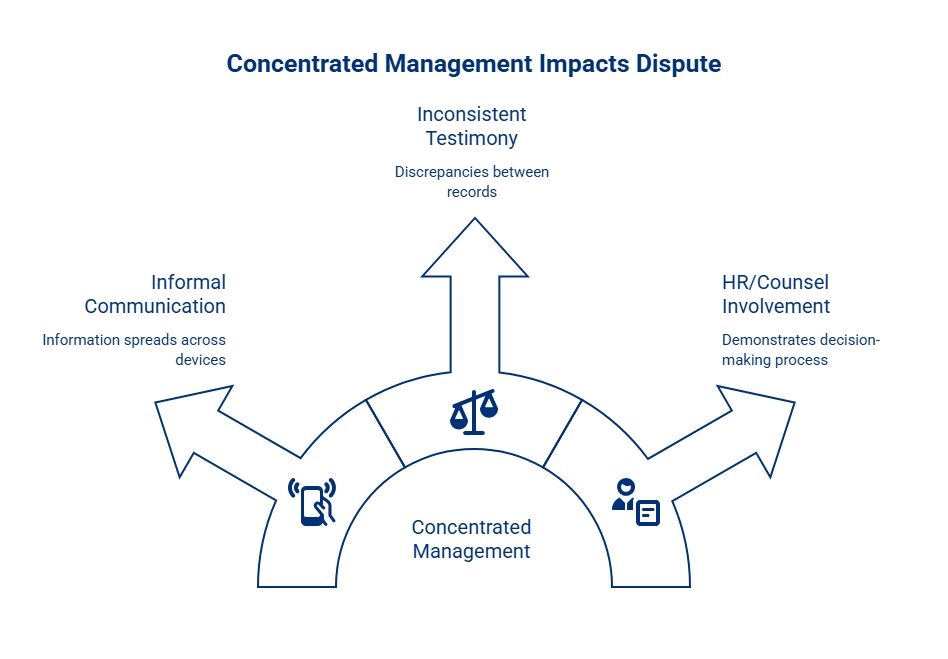
Family-owned businesses often assign several functions to the same people. An owner may supervise employees, approve payroll, respond to complaints, impose discipline, and authorize termination. A relative may control scheduling while maintaining personnel records.
This concentration can make a small group of decision-makers central to both the break allegations and the termination claim. Informal communications may spread relevant information across personal devices, handwritten notes, payroll systems, and workplace accounts. While informal communication is standard in such environments, inconsistencies between testimony and contemporaneous records frequently become the center of the dispute.
The participation of human-resources personnel or employment counsel before a sensitive decision may also become part of the factual history. This involvement typically demonstrates how the business evaluated the available information, interpreted applicable policies, and finalized the basis for its decision.
One Employment Decision May Generate Several Claims
Depending on the pleaded facts and supporting evidence, a dispute may include:
- Meal- or rest-period allegations.
- Statutory retaliation claims.
- Wrongful termination in violation of public policy.
- Related overtime, off-the-clock, or payroll claims arising from the same records.
Each cause of action has separate legal requirements, but the claims may depend on overlapping documents and witnesses. This overlap can expand wage-and-hour litigation beyond the employee’s original complaint. Allegations involving other employees may broaden the dispute further when the pleadings and evidence support that scope.
For a family-owned business, the resulting burden may affect management time, staff coverage, payroll administration, customer relationships, employee morale, cash flow, and business planning. Those operational effects can arise before a court or agency reaches any determination concerning fault or liability.
Considerations That May Reduce Exposure for Family-Owned Businesses
Employers can actively manage the risks described above. How a family-owned business documents its employment decisions, manages complaints, and applies its policies may affect its position if a dispute arises. Areas that may warrant attention include how the business records and tracks employee complaints, whether disciplinary actions follow the steps outlined in its own written policies, whether similarly situated employees receive consistent treatment when similar issues arise, and whether employment decisions are documented in a way that reflects the business’s stated reasons at the time they are made. An effective policy requires employees to sign a standardized acknowledgment when they choose to waive a valid meal period, creating a verifiable paper trail that protects the business. When a single owner or family member handles both the complaint and the later employment action, the overlap may become a focal point in any resulting dispute. Consulting with employment defense counsel before making a sensitive termination decision, rather than after a claim is filed, may allow the business to identify and address potential vulnerabilities while the record is still developing.
Disclaimer:
This content is for informational purposes only. Laws, definitions, and deadlines change. Verify current requirements through official California sources. This content is not legal advice. No attorney-client relationship is formed through this content. Please consult a qualified attorney in your jurisdiction for legal advice specific to your situation.
Protect Your Business | The Akopyan Law Firm, A.P.C. | Top Gun Employment Defense Lawyers
Have you been sued by an employee? Are you overwhelmed by the complexities of employment law? If so, give us a call. The Akopyan Law Firm, A.P.C. assists small business owners throughout Southern California. Our seasoned employment defense lawyers stand ready to help employers quickly and efficiently resolve employment disputes. We are ready to aggressively and skillfully defend against any employment case, but understand that in most situations avoiding the expense of litigation is in the client’s best interest.
Take the First Step Protecting Your Future: Call us today to speak with one of our experienced employment lawyers.
Contact Us Today:
- Phone: (818) 509-9975
- Office Locations in Southern California: Los Angeles, Bakersfield, Costa Mesa, Temecula, Rancho Cucamonga, Oxnard, Culver City, and San Diego.