
📌 Key Takeaways
Leave-related termination claims often turn on whether a protected leave request appears causally connected to the employment decision.
- Sequence Drives Scrutiny: A protected leave request followed by termination may draw scrutiny of timing, knowledge, records, and stated business reasons.
- Dental Operations Matter: Patient scheduling, hygienist coverage, assistant staffing, billing continuity, and treatment-room productivity can make these disputes especially disruptive.
- Records Become Evidence: Schedules, payroll entries, texts, emails, leave notes, and supervisor communications may later shape the factual narrative.
- Claims Often Expand: Leave-related termination allegations may overlap with retaliation, disability accommodation, pregnancy-related leave, whistleblower, or wage-related claims.
- Consistency Supports Defensibility: Contemporaneous records, consistent explanations, and alignment with established workplace practices may affect how the termination decision is evaluated.
Protected leave disputes are rarely about one decision; they are often about timing, context, documentation, and credibility.
Southern California dental practice owners facing leave-related termination allegations will gain a focused risk overview here, guiding them into the litigation-specific details that follow.
~ ~ ~ ~ ~ ~ ~ ~ ~ ~ ~ ~ ~ ~ ~ ~ ~ ~
A wrongful termination claim involving a protected leave request may create serious exposure for a Southern California dental practice when an employee alleges that termination was causally connected to medical leave, pregnancy-related leave, family leave, disability accommodation, or retaliation for asserting workplace rights. These claims can become especially disruptive for owner-operated dental practices because the same records used to run the office—schedules, payroll data, text messages, emails, leave notes, and supervisor communications—may later be scrutinized in litigation.
Why Protected Leave Requests Can Become Wrongful Termination Claims
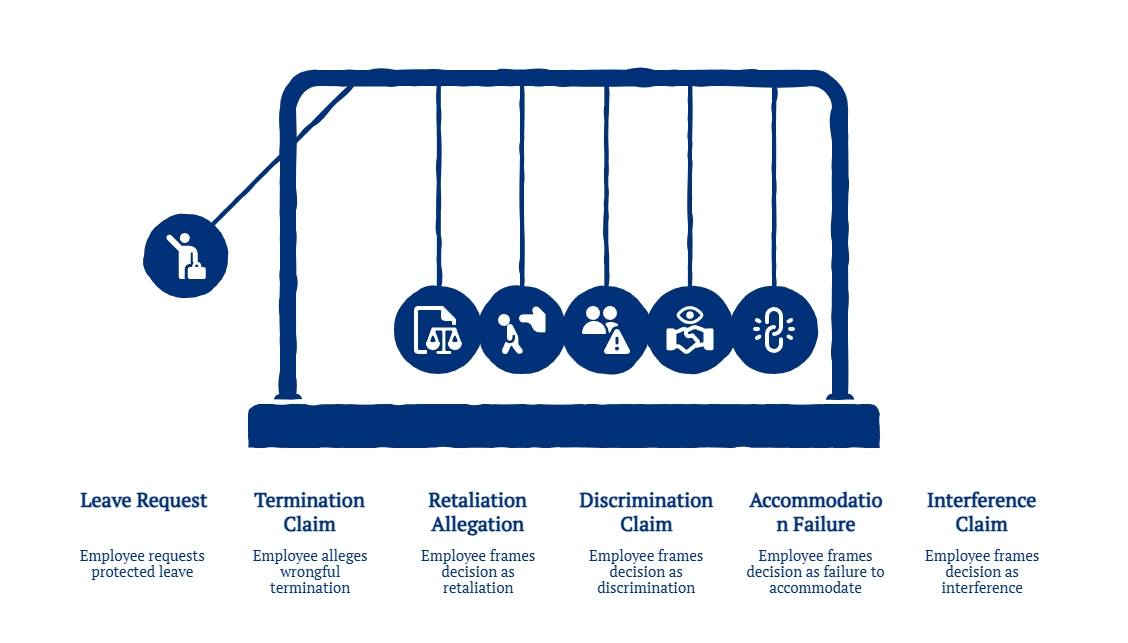
Leave-related wrongful termination claims often focus on sequence and causation. An employee may request protected leave, disclose a disability or qualifying medical condition, raise a pregnancy-related issue, ask about family or medical leave, or discuss a possible accommodation. If the practice later ends employment, the employee may allege that the termination was not merely a staffing decision, performance decision, or business decision, but an employment decision connected to protected activity or protected status.
A dentist-owner, office manager, or supervisor may view the termination as based on attendance, patient coverage, chairside performance, front-office reliability, interpersonal conflict, or business necessity. The employee may frame the same decision as retaliation, discrimination, failure to accommodate, or interference with protected leave rights. In litigation, the dispute may center on what the practice’s decision-makers knew, when they knew it, when the termination decision was made, and whether the stated reason appears consistent with contemporaneous records.
Timing alone does not necessarily establish retaliation. Still, proximity between a protected leave request and termination may receive close attention, especially when the employee challenges the employer’s asserted legitimate, nondiscriminatory reason.
Why These Claims Can Disrupt Dental Practices Quickly
Many owner-operated dental offices may not have the management layers found in larger corporate workplaces. A single absence may affect patient scheduling, hygienist coverage, dental assistant assignments, sterilization flow, billing continuity, and treatment-room productivity. When a leave-related termination claim surfaces, the disruption may extend beyond the former employee’s position.
A dentist-owner may become a key witness. An office manager may be asked to explain communications about staffing or schedule coverage. A supervisor’s text message about availability, a revised patient calendar, a payroll entry, or an internal note about attendance may take on added significance after a lawsuit, demand letter, regulatory notice, or agency complaint has surfaced.
For a small dental practice, the business impact is often practical and immediate. The dispute may affect staffing stability, employee morale, cash flow, reputation, patient continuity, and management bandwidth at the same time.
Common Leave-Related Allegations in Dental Employment Disputes
A termination following a protected leave request may be pleaded as more than one employment claim. The employee may allege wrongful termination, retaliation, disability discrimination, failure to accommodate, failure to engage in the interactive process, pregnancy discrimination, or interference with family and medical leave rights.
Illustrative allegations may include, among others:
- A dental assistant may allege that termination followed a request for medical leave connected to a disability or qualifying medical condition.
- A hygienist may allege that reduced hours or schedule changes followed a pregnancy-related leave discussion.
- A front-office employee may allege that termination followed a request for time away to address a family or medical issue.
- An office manager may allege that discipline or termination followed complaints about scheduling, pay practices, patient-care concerns, or alleged legal violations.
California family and medical leave concepts primarily center on the California Family Rights Act (CFRA), which applies to any employer with 5 or more employees, whereas federal protections fall under the Family and Medical Leave Act (FMLA), which requires a threshold of 50 or more employees [Gov. Code, § 12945.2; 29 U.S.C. § 2611(2)]. For micro-practices with fewer than 5 employees, these specific extended family leave acts do not apply; however, these small practices are still strictly bound by California’s mandatory Paid Sick Leave laws, which protect time off for all employees from day one regardless of workforce size [Cal. Labor Code § 246]. These differing statutory boundaries frequently overlap with disability accommodation, pregnancy protections, and retaliation claims, meaning a dental practice’s exact employee count dictates its true legal exposure.
Disability Accommodation and Interactive Process Issues
Protected leave requests may overlap with reasonable accommodation issues when an employee has a disability or qualifying medical condition. In California, for practices maintaining 5 or more employees, the Fair Employment and Housing Act (FEHA) mandates an explicit, standalone obligation to engage in a timely, good-faith interactive process to identify effective adjustments [Gov. Code § 12940(n); Shirvanyan v. Los Angeles Community College District (2020) 56 Cal.App.5th 112]. In that setting, a legal dispute often focuses less on the termination itself and more on whether the practice’s communications met this rigorous statutory standard.
While a dentist-owner may view the situation purely as an operational or attendance disruption, an employee within a covered practice may assert separate causes of action for failure to accommodate, failure to engage in the interactive process, or disability-based discrimination. The litigation will center on whether the employee could perform the essential job functions with adjustments, whether an accommodation posed an unproven ‘undue hardship,’ and whether contemporaneous documentation validates the practice’s decision-making timeline [Gov. Code § 12940(m)].
Pregnancy-related leave introduces a complex, multi-layered statutory dynamic under California law. For practices with 5 or more employees, California Pregnancy Disability Leave (PDL) provides up to four months of job-protected leave for pregnancy-related conditions, and remarkably, has no minimum tenure or hours-worked requirement—protecting an employee from day one [Gov. Code, § 12945; 2 CCR § 11042]. Crucially for dental staffing, PDL does not run concurrently with CFRA bonding leave; instead, an eligible employee can ‘stack’ them, taking up to four months of disability leave followed by 12 weeks of child-bonding leave, totaling nearly seven months of protected absence [Cal. Code Regs., tit. 2, § 11090]. Additionally, employers must respect California’s Reproductive Loss Leave (SB 848), which grants up to 5 days of protected leave for miscarriages or failed reproductive procedures. In a dental office, these overlapping mandates frequently intersect with physical job requirements—such as long chairside standing periods, sterilization duties, or treatment-room scheduling—making absolute clarity on ‘stacked’ timelines and the good-faith interactive process essential to preventing catastrophic retaliation or failure-to-accommodate claims.
Why Records, Timing, and Consistency Often Receive Scrutiny
Leave-related termination claims often turn on ordinary workplace records. Dental practices use schedules, timekeeping records, payroll entries, patient calendars, text messages, emails, performance notes, and internal communications to run the business. In litigation, those same materials may become part of the factual record.
The issue is not only what a record says. The issue may also involve what the record appears to show about timing, consistency, decision-making, and credibility. A routine message about coverage, a schedule revision, or an email about availability may be interpreted differently after the employee alleges that protected leave, disability, pregnancy, family medical needs, or protected activity influenced the termination.
Contemporaneous records, consistent explanations, and alignment with established workplace practices may become important to the defensibility of an employment decision. Inconsistent documentation, deviation from stated policy, or shifting explanations may increase scrutiny even when the practice believes it had a legitimate business reason for the termination.
Active litigation can also raise preservation, attorney-client privilege, work product, electronic communications, and discoverability concerns. These issues generally involve legal judgment because they can affect how a claim is evaluated, defended, or resolved.
How Leave-Related Termination Claims Can Expand Into Retaliation or Wage-Related Allegations
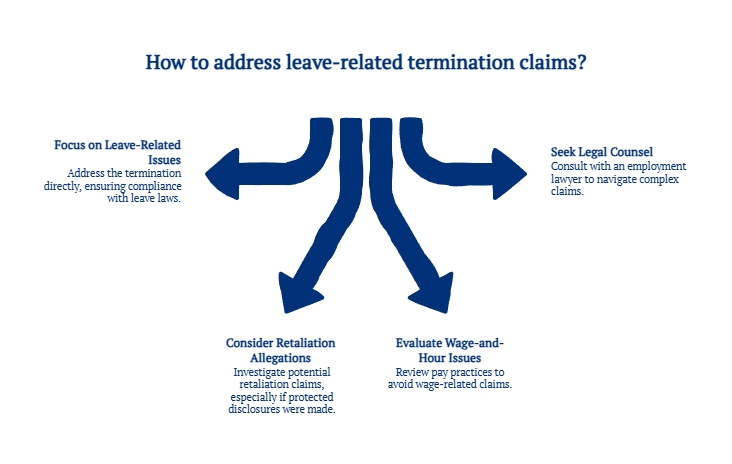
Leave-related wrongful termination claims may expand when the employee also alleges protected complaints about wages, scheduling, safety, patient-care concerns, billing practices, or other alleged legal violations. In California, whistleblower retaliation concepts may arise when an employee claims protected disclosure activity or refusal to participate in allegedly unlawful conduct.
This overlap can change the character of the dispute. What begins as a termination-after-leave claim may become a broader unlawful retaliation or whistleblower retaliation matter. If the allegations also involve pay practices, missed breaks, overtime, or timekeeping, the claim may intersect with wage-and-hour issues as well.
Allegation-based framing matters. The existence of a claim does not establish that the dental practice violated the law. It means the practice may be facing a dispute in which documents, witness accounts, timing, consistency, protected activity, protected status, and legitimate business reasons may receive close attention.
Why Experienced Employer-Side Employment Litigation Counsel Matters
When a Southern California dental practice receives a lawsuit, demand letter, regulatory notice, agency complaint, or serious threatened claim, the matter may involve strict response obligations and serious consequences if mishandled. Those consequences may include default judgment, sanctions, expanded exposure, or avoidable escalation.
Experienced employer-side employment litigation attorneys can be especially important because leave-related termination claims often combine legal complexity with operational pressure. These disputes may involve overlapping medical leave, pregnancy-related leave, disability accommodation, retaliation, whistleblower, and wage-related allegations while the practice is still managing patients, schedules, staff coverage, and revenue demands.
For many owner-operated dental employers, the practical concern is not abstract compliance education. The concern is protecting the practice while a serious employment dispute affects employees, records, patient care, reputation, and management attention.
Disclaimer:
This content is for informational purposes only. Laws, definitions, and deadlines change. Verify current requirements through official California sources. This content is not legal advice. No attorney-client relationship is formed through this content. Please consult a qualified attorney in your jurisdiction for legal advice specific to your situation.
Protect Your Business | The Akopyan Law Firm, A.P.C. | Top Gun Employment Lawyers
Have you been sued by an employee? Are you overwhelmed by the complexities of employment law? If so, give us a call. The Akopyan Law Firm, A.P.C. assists small business owners throughout Southern California. Our seasoned employment defense lawyers stand ready to help employers quickly and efficiently resolve employment disputes. We are ready to aggressively and skillfully defend against any employment case, but understand that in most situations avoiding the expense of litigation is in the client’s best interest.
Take the First Step Protecting Your Future: Call us today to speak with one of our experienced employment defense lawyers.
Contact Us Today:
- Phone: (818) 509-9975
- Office Locations in California: Los Angeles, Bakersfield, Costa Mesa, Temecula, Rancho Cucamonga, Oxnard, Culver City, and San Diego.