

📌 Key Takeaways
Complaint-related termination claims can shift a restaurant dispute from a personnel decision to a litigation record focused on protected activity, timing, motive, and consistency.
- Timing Drives Scrutiny: A termination following an alleged workplace complaint may make motive, sequence, and credibility central to the dispute.
- Complaints Expand Claims: Wage, break, harassment, discrimination, safety, or scheduling complaints may support overlapping wrongful termination and retaliation theories.
- Records Shape Defensibility: Schedules, payroll data, texts, disciplinary records, and contemporaneous communications may affect how the stated business reason is evaluated.
- Operations Create Complexity: Informal restaurant decision-making can become fact-intensive when owners, managers, supervisors, and shift leads give competing context.
- Focused Defense Matters: Active claims involving protected activity, disputed timing, and wage-and-hour allegations generally call for experienced employer-side litigation attention.
A workplace complaint can turn an ordinary termination dispute into a broader challenge to consistency, credibility, and business justification.
California restaurant employers facing employee lawsuits, agency complaints, or attorney demands will gain immediate clarity here, guiding them into the complaint-related termination claim details that follow.
~ ~ ~ ~ ~ ~ ~ ~ ~ ~ ~ ~ ~ ~ ~ ~ ~ ~
When a California restaurant employee alleges that termination followed a workplace complaint, the dispute may shift from a routine separation to a contested employment claim involving protected activity, timing, motive, consistency, and pretext. The restaurant may maintain that the termination was based on a legitimate business reason. The former employee may assert that the stated reason was connected to, or used to conceal, retaliation.
For small restaurants, these claims can feel both personal and disruptive. Owners, general managers, supervisors, and shift leads may understand the staffing pressures, attendance issues, service demands, and performance concerns behind a decision. A lawsuit, agency complaint, or attorney demand may present the same facts through a different legal narrative. Complaint-related termination allegations often call for focused wrongful termination defense and retaliation defense rather than generalized workplace management discussion.
Workplace Complaints Can Change the Focus of a Termination Dispute
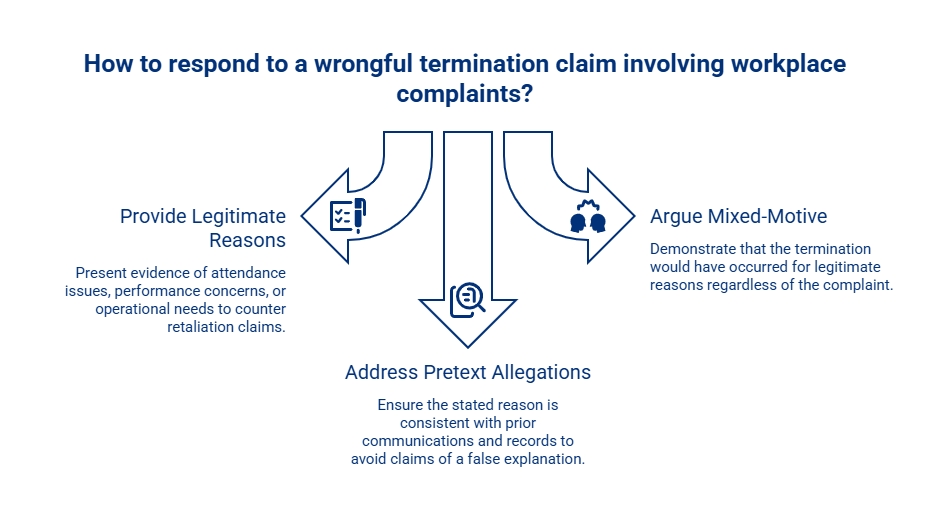
A restaurant may contend that termination resulted from attendance problems, performance concerns, misconduct, restructuring, or operational needs. A former employee may allege that the same termination occurred because the employee previously complained about workplace conditions. Once that allegation appears in a legal claim, the dispute may extend beyond whether the restaurant had concerns about the employee’s work.
The claim may examine whether the stated reason is consistent with earlier communications, scheduling decisions, payroll records, supervisor comments, contemporaneous records, or the prior treatment of similarly situated employees. A trier of fact may consider how the employment decision developed and how the restaurant’s explanation fits the broader record.
While California remains an at-will employment state under Labor Code § 2922, this presumption is strictly limited by statutory and common law exceptions. At-will status provides no immunity against claims of retaliation or discrimination under the Fair Employment and Housing Act (FEHA) or the California Labor Code. Specifically, if a termination is motivated even in part by a ‘protected activity’—such as reporting wage theft under Labor Code § 98.6 or whistleblowing under § 1102.5—the at-will defense is largely effectively neutralized. However, employers should be aware of the ‘mixed-motive’ defense established in Harris v. City of Santa Monica, 56 Cal.4th 203 (2013). Under Harris, if an employer can prove it would have reached the ‘same decision’ for legitimate reasons regardless of the retaliatory motive, the employee’s remedies may be limited to declaratory relief and attorney fees, rather than full economic damages or reinstatement. In these disputes, California courts apply the McDonnell Douglas burden-shifting framework: once an employee establishes a prima facie case of retaliation, the burden shifts to the employer to provide a non-retaliatory, legitimate business reason. However, the employee may still prevail by demonstrating that the employer’s stated reason was a ‘pretext’—a legal mask for a retaliatory motive (See Tameny v. Atlantic Richfield Co., 27 Cal.3d 167).
Restaurant Workplace Complaints That May Precede Termination Claims
In restaurant employment litigation, the alleged complaint may involve several different workplace issues. The complaint is not always formal or written. A former employee may claim that a verbal report, text message, conversation with a manager, or internal objection preceded the termination or another employment decision.
Common allegations may include the following:
- An employee may allege protected activity based on complaints about wages, overtime, off-the-clock work, minimum wage, tip practices, meal periods, or rest breaks.
- An employee may allege protected activity based on complaints about harassment, discrimination, supervisor conduct, customer-facing conflict, or treatment by a shift lead.
- An employee may allege protected activity based on complaints about safety concerns, scheduling disputes, leave-related issues, or management conduct.
These categories may overlap. A former line cook may allege termination after complaints about missed meal periods or unpaid time. A server may claim reduced shifts and later termination after complaints about tip practices. A cashier may allege retaliation after reporting harassment by a supervisor or shift lead.
The restaurant may dispute the allegation, the timing, the meaning of the communication, or the claimed causal connection. That disputed factual record is often what makes these cases difficult.
Wrongful Termination and Retaliation Theories Often Overlap
A single termination event often triggers a ‘multi-theory’ complaint, combining statutory retaliation with common law ‘wrongful termination in violation of public policy.’ These claims, while overlapping in facts, have distinct procedural requirements. For instance, claims for retaliation under the FEHA (Gov. Code § 12940(h)) generally require the exhaustion of administrative remedies through the Civil Rights Department (CRD) before a lawsuit can be filed. Conversely, a Tameny claim for wrongful termination in violation of public policy may be filed directly in court. Furthermore, Labor Code § 1102.5 provides distinct whistleblower protection that carries a lower burden of proof for plaintiffs than traditional discrimination claims, as the ‘contributing factor’ standard may apply (See Lawson v. PPG Architectural Finishes, Inc., 12 Cal.5th 703 (2022))
Under California law, generally, retaliation claims may arise when an employee alleges that protected activity was followed by an adverse employment action. Wrongful termination claims may involve allegations that the termination violated public policy or was connected to legally protected conduct. The application of those principles depends on the specific facts, claims, parties, and governing law.
For restaurant employers, the practical concern is case expansion. A claim that begins with one employee’s termination may grow to include payroll practices, management communications, supervisor conduct, uniform application of established policies, or treatment of other employees. The pleaded claims, disputed facts, available records, and witness credibility may all affect the scope and complexity of the dispute.
Restaurant Operations Can Create Fact-Intensive Litigation
Restaurants often operate through fast-moving decisions. Owners and general managers may adjust staffing levels. Supervisors may respond to absences, service rushes, customer issues, and performance concerns.
In the fast-paced restaurant environment, informal communications from shift leads and supervisors—via SMS, WhatsApp, or scheduling apps—are often treated by California courts as the ‘admissions of a party-opponent’ under Evidence Code § 1222. Under the principle of respondeat superior, a restaurant can be held vicariously liable for the retaliatory conduct or statements of its supervisors, even if ownership was unaware of the specific interaction.
Furthermore, if a ‘cat’s paw’ scenario exists—where a biased supervisor’s retaliatory animus proximately causes an adverse action by an ‘entirely innocent’ decision-maker—the employer may still be held liable for retaliation. While Burlington N. & S.F.R. Co. v. White, 548 U.S. 53 (2006) established the standard for what constitutes a ‘materially adverse’ action, the ‘cat’s paw’ doctrine was specifically refined by the U.S. Supreme Court in Staub v. Proctor Hospital, 562 U.S. 411 (2011). Under this doctrine, an employer cannot escape liability simply because the final decision-maker was unaware of the supervisor’s retaliatory intent, if intent was a causal factor in the ultimate termination.
A plaintiff may point to a manager’s message, schedule change, disciplinary note, payroll entry, or deviation from prior practice as material relevant to motive. The restaurant may view the same material as ordinary business activity unrelated to any workplace complaint.
The litigation record may include schedules, timekeeping materials, payroll data, disciplinary records, emails, texts, and testimony from owners, general managers, supervisors, and shift leads. Contemporaneous and consistent records may affect how the parties frame timing, consistency, credibility, and the defensibility of the stated business reason.
Timing and Stated Reasons Often Receive Close Scrutiny
A former employee may argue that proximity between alleged protected activity and termination supports a retaliation theory. The restaurant may identify a different explanation based on performance, attendance, conduct, staffing needs, restructuring, or another legitimate business reason. The dispute may then focus on whether the explanation appears consistent and defensible considering the broader record.
Timing alone does not resolve the claim. Documentation alone does not automatically defeat it. A trier of fact may consider the sequence of events, the decision-makers involved, the stated reason for termination, whether established policies were applied uniformly, and whether the restaurant’s explanation remained consistent.
For a small restaurant, this scrutiny can be challenging because employment decisions may have occurred in a practical and informal operating environment. Litigation may require those decisions to be evaluated in a formal evidentiary setting.
Wage-and-Hour Complaints Can Expand the Case
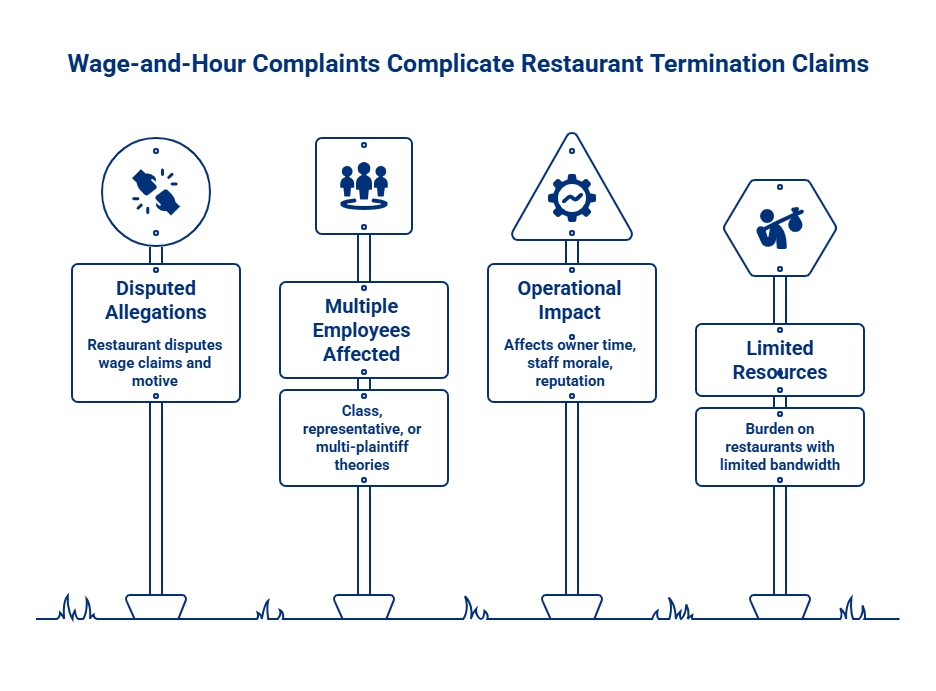
Restaurant termination claims can become more complex when the alleged complaint involves wages, breaks, overtime, tips, or off-the-clock work. A termination dispute may then connect to broader wage-and-hour defense issues. Allegations involving meal periods or rest breaks may also draw attention to meal and rest break disputes beyond the separation itself.
A former employee may allege that the restaurant ended employment after complaints about missed breaks, unpaid time, tip practices, or overtime. The restaurant may dispute both the underlying wage allegation and the alleged retaliatory motive. If the allegations are framed as affecting more than one employee, the dispute may create additional complexity through class, representative, or multi-plaintiff theories.
This risk is not only legal. Active employment litigation may affect owner time, staff morale, reputation, financial planning, and daily operations. For restaurants with limited management bandwidth and no in-house legal department, the burden can be substantial.
Active Complaint-Related Termination Claims Call for Focused Employer-Side Defense
Wrongful termination and retaliation claims involving workplace complaints are rarely limited to one document or one conversation. They often involve competing narratives about what happened, why it happened, who knew what, and whether the termination was connected to protected activity.
California restaurant employers facing a lawsuit, attorney demand, agency complaint, or credible threat of litigation generally benefit from early involvement of employment defense counsel, especially when the dispute involves alleged protected activity, disputed timing, inconsistent records, or overlapping wage-and-hour issues. The purpose is not to turn the restaurant owner into a litigator. The purpose is to ensure that serious allegations receive focused employer-side litigation attention before the dispute becomes more difficult, expensive, or disruptive.
Disclaimer:
This content is for informational purposes only. Laws, definitions, and deadlines change. Verify current requirements through official California sources. This content is not legal advice. No attorney-client relationship is formed through this content. Please consult a qualified attorney in your jurisdiction for legal advice specific to your situation.
Protect Your Business | The Akopyan Law Firm, A.P.C. | Top Gun Employment Lawyers
Have you been sued by an employee? Are you overwhelmed by the complexities of employment law? If so, give us a call. The Akopyan Law Firm, A.P.C. assists small business owners throughout Southern California. Our seasoned employment defense lawyers stand ready to help employers quickly and efficiently resolve employment disputes. We are ready to aggressively and skillfully defend against any employment case, but understand that in most situations avoiding the expense of litigation is in the client’s best interest.
Take the First Step Protecting Your Future: Call us today to speak with one of our experienced employment lawyers.
Contact Us Today:
- Phone: (818) 509-9975
- Office Locations in California: Los Angeles, Bakersfield, Costa Mesa, Temecula, Rancho Cucamonga, Oxnard, Culver City, and San Diego.