
📌 Key Takeaways
A wage-and-hour complaint may become a retaliation dispute when a later termination or other employment decision is alleged to be connected to protected activity.
- Protected Activity Matters: A complaint about unpaid wages, overtime, meal periods, rest periods, pay statements, or minimum wage compliance may trigger retaliation protections.
- Termination Changes Exposure: A later termination may shift the dispute from payroll compliance to causation, motive, timing, and the employer’s stated reason.
- Statutory Presumption of Retaliation: Under California’s Senate Bill 497 (the ‘Equal Pay and Anti-Retaliation Act’), effective January 1, 2024, there is now a rebuttable presumption of retaliation if an employer disciplines or terminates an employee within 90 days of certain protected activities, including wage-and-hour complaints. [California Labor Code §§ 98.6, 1102.5, and 1197.5 (as amended by SB 497)] This shifts the initial burden to the employer to provide a legitimate, non-retaliatory reason for the action, making timing not just a supporting factor, but a legal trigger for liability.
- Proactive Audits as a Statutory Defense: In 2026, documentation is more than a ‘weighty’ factor; it is a formal legal shield. Under the 2024 PAGA Reforms (SB 92/AB 2288), businesses that take ‘all reasonable steps’ to comply, such as conducting periodic payroll audits and training supervisors before a dispute arises, can cap their penalty exposure at 15% to 30% of the statutory maximum. For family businesses, this ‘reasonable steps’ defense is the primary mechanism to avoid ruinous representative litigation.
- Family Businesses Feel It More: Direct owner involvement, informal communications, and shorter decision chains may intensify legal, operational, and reputational pressure.
A pay dispute may start with compensation law but expand into a broader challenge to timing, explanation, and credibility.
California family-owned businesses facing wage-and-hour complaints and later termination allegations will gain immediate clarity here, guiding them into the dispute-specific details that follow.
~ ~ ~ ~ ~ ~ ~ ~ ~ ~ ~ ~ ~ ~ ~ ~ ~ ~
Under California law, generally, a wage-and-hour complaint may become the starting point for a broader retaliation dispute when an employee raises concerns about unpaid wages, overtime, meal periods, rest periods, pay statements, or minimum wage compliance and a later termination or other employment decision follows. California Labor Code section 98.6 protects employees who complain orally or in writing about unpaid wages or exercise rights under the Labor Code, and federal wage-and-hour law also prohibits retaliation for asserting pay-related rights or cooperating in an investigation. Laws may change, and this discussion provides general information rather than legal advice.
For that reason, a dispute that first appears limited to payroll practices may not remain limited to payroll practices. What begins as a disagreement about compensation may later be alleged as protected activity followed by retaliatory treatment. In that setting, a complaint involving wage-and-hour allegations may overlap with claims framed as wrongful termination or unlawful retaliation.
Why a Later Termination May Change the Case
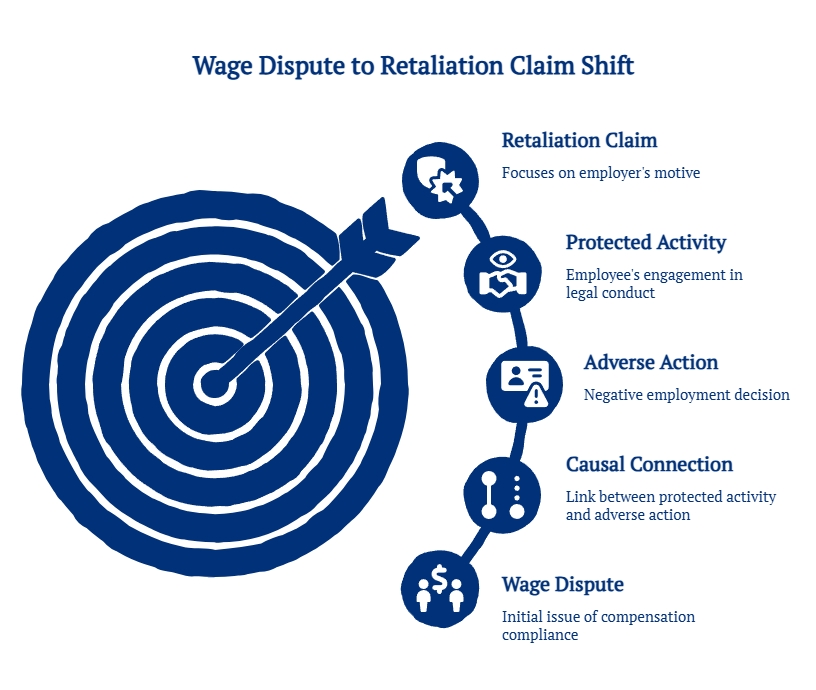
A wage dispute usually asks whether the employer complied with compensation laws. A retaliation claim asks a different set of questions. The inquiry may shift to whether the earlier complaint qualifies as protected activity, whether a later termination or other employment decision caused a material change in the employee’s status, and whether the timing and stated reason support an alleged causal connection. California and federal retaliation rules both focus on whether the employer took adverse action because the employee engaged in protected conduct.
That shift matters because the case may stop turning only on pay calculations and start turning on motive, timing, and explanation. Close temporal proximity between a wage complaint and a later termination may be used to support an alleged causal connection. A family-owned business may therefore face a broader dispute not simply because a pay issue was raised, but because the later employment decision may be examined through a retaliation lens.
How Timing, Documentation, and Stated Reasons Shape the Dispute
Once a retaliation theory enters the case, chronology often becomes central. Owners, supervisors, and managers may be asked when the wage complaint was raised, who received it, how it was discussed internally, when discipline began, and when the termination decision was made. Payroll records, personnel records, emails, messages, and the employer’s stated reason for termination may all be read together rather than separately.
The legal significance of timing is only part of the picture. Consistent and contemporaneous documentation may carry unusual weight in a dispute of this kind. So may the uniform application of stated policies and stated reasons. A defensible employment decision usually depends on whether the employer’s explanation remains consistent across records, communications, and witness accounts, not merely on whether a business believed the decision was justified when it was made.
A simple example shows how the dispute may widen. An employee complains about unpaid overtime. Two weeks later, the business terminates the employee for performance reasons, but earlier personnel records describe the employee in stronger terms and do not reflect the same concern. In that setting, the case may shift quickly from an overtime compensation dispute to a retaliation claim focused on timing, documentation, and pretext.
A second example may arise in a family-run workplace with informal management communications. An owner responds informally to a complaint about meal and rest break practices, but a later termination is supported by more formal reasons that were not documented in the same way at the time of the complaint. That kind of inconsistency may increase scrutiny even where the business maintains that the decision rested on legitimate, nondiscriminatory, and nonretaliatory grounds.
Why Family-Owned Businesses May Face Added Pressure
Family-owned businesses often operate with direct owner involvement, shorter decision chains, and less formal communication patterns. Those business realities do not establish liability by themselves. They may, however, shape how a dispute is investigated, pleaded, and evaluated. When the same people handle payroll concerns, discipline, and termination decisions, they may become central fact witnesses. Informal communications may also assume outsized importance when the record is later examined as a whole.
The practical pressure may extend beyond legal exposure. A dispute that began with minimum wage or payroll issues may grow into a broader challenge to the business’s decision-making process, internal consistency, and stated motives. Management attention may be diverted. Operations may be disrupted. Reputational strain may increase. For a closely held business, those consequences may feel far more serious than the original pay complaint suggested.
Why the Overlap May Broaden Potential Exposure
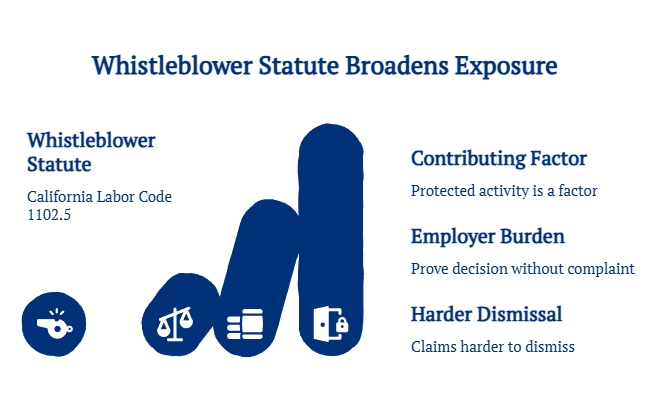
In many disputes, an employee may leverage California Labor Code section 1102.5, often referred to as the ‘general’ whistleblower statute. Under the framework established in Lawson v. PPG Architectural Finishes, Inc. (2022), an employee only needs to show that their protected activity was a ‘contributing factor’ in the adverse action. Once shown, the burden shifts heavily to the employer, who must prove by ‘clear and convincing evidence’ that they would have made the same decision even if the employee had never complained. This is a much higher evidentiary bar than the ‘preponderance of the evidence’ standard used in most civil cases. This lower ‘contributing factor’ standard makes these claims significantly harder for family-owned businesses to dismiss before trial. That statute protects certain disclosures of information the employee reasonably believes show unlawful conduct or regulatory noncompliance. As a result, a pay complaint may sometimes be framed as both a wage-and-hour issue and a broader retaliation or whistleblower issue, depending on the facts alleged.
Not every termination following a wage complaint is unlawful, and not every wage dispute becomes a retaliation case. These matters are fact specific. Still, once a wage-and-hour complaint is treated as protected activity, a later termination or other employment decision may be examined for causal connection, consistency, and pretext rather than for compensation compliance alone.
Disclaimer:
This content is for informational purposes only. Laws, definitions, and deadlines change. Verify current requirements through official California sources. This content is not legal advice. No attorney-client relationship is formed through this content. Please consult a qualified attorney in your jurisdiction for legal advice specific to your situation.
Protect Your Business | The Akopyan Law Firm, A.P.C. | Top Gun Employment Lawyers
Have you been sued by an employee? Are you overwhelmed by the complexities of employment law? If so, give us a call. The Akopyan Law Firm, A.P.C. assists small business owners throughout Southern California. Our seasoned employment defense lawyers stand ready to help employers quickly and efficiently resolve employment disputes. We are ready to aggressively and skillfully defend against any employment case, but understand that in most situations avoiding the expense of litigation is in the client’s best interest.
Take the First Step Protecting Your Future: Call us today to speak with one of our experienced employment lawyers.
Contact Us Today:
- Phone: (818) 509-9975
- Office Locations in California: Los Angeles, Bakersfield, Costa Mesa, Temecula, Rancho Cucamonga, Oxnard, Culver City, and San Diego.