

📌 Key Takeaways
In Southern California restaurant disputes, wrongful termination and retaliation claims often travel together because one termination may become a broader dispute about motive, timing, documentation, and management communications.
- One Termination, Two Claims: A plaintiff may challenge the termination itself while also alleging that protected activity caused the same employment decision.
- Protected Activity Expands Scrutiny: Once protected activity enters the dispute, timing, internal records, supervisor statements, and shifting explanations may receive closer review.
- Restaurant Facts Raise Risk: Lean staffing, direct supervision, and informal communication may make restaurant employment decisions easier to frame as overlapping claims.
- Pretext Becomes Central: A complaint may allege that a stated performance reason was not the real reason, placing causation and consistency at issue.
- Business Disruption Follows Quickly: These paired allegations may increase potential exposure, legal expense, operational strain, and pressure on small owner-operated restaurants.
One separation decision may become a much larger California restaurant employment dispute when retaliation is alleged alongside wrongful termination.
Southern California restaurant owners facing lawsuits, demand letters, or agency complaints will gain immediate clarity here, guiding them into the California restaurant litigation details that follow.
~ ~ ~ ~ ~ ~ ~ ~ ~ ~ ~ ~ ~ ~ ~ ~ ~ ~
Under California law, generally, wrongful termination and retaliation claims often appear together because the same termination may support more than one theory of liability. A plaintiff may allege that the termination itself was unlawful, and the same plaintiff may also allege that the termination occurred because the employee engaged in protected activity. For California restaurant employers, that overlap may convert one separation decision into a broader dispute about motive, chronology, contemporaneous records, and management communications.
Why These Claims Are Commonly Pleaded Together
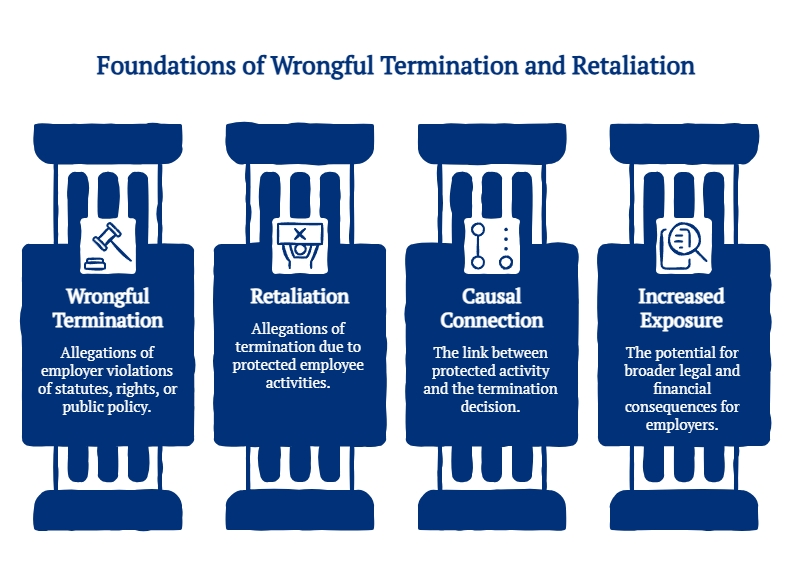
A wrongful termination claim and a retaliation claim are distinct, but they frequently arise from the same employment event. Wrongful termination allegations may assert that the employer violated a statute, a protected legal right, or California public policy. Retaliation allegations may assert that the employer made the termination decision because the employee made a protected complaint, opposed unlawful conduct, reported a concern of unlawful activities, requested a disability leave, or otherwise engaged in protected activity.
That pairing matters because it broadens the dispute. Once both theories appear in the complaint, the case may focus less on the stated reason for termination in isolation and more on whether the plaintiff can allege a causal connection between protected activity and the termination decision. In many restaurant cases, that shift may increase potential exposure, expand the factual record, and intensify scrutiny of the employer’s explanation.
How a Termination Can Become a Retaliation Dispute
Restaurant employers often operate through owner-managers, shift supervisors, lean staffing, and fast-moving decisions. In that setting, a plaintiff may frame the termination not simply as a stand-alone employment decision, but as the employer’s response to protected activity.
For illustrative purposes only, a complaint may allege that a restaurant employee raised a workplace concern and was later terminated. The complaint may characterize that same event as both wrongful termination and retaliation. As a generalized example, a plaintiff may claim that the restaurant employer cited performance problems, but the contemporaneous record contains positive evaluations, few disciplinary write-ups, or manager communications that do not align with the stated reason for termination. Those allegations do not establish liability, but they may create substantial employer-side risk because they place causation and pretext at the center of the case.
Why Protected Activity Often Expands Employer Exposure
Protected-activity allegations often change the legal and factual emphasis of the dispute. The restaurant employer may maintain that it acted for a legitimate business reason or a legitimate, nondiscriminatory reason. The plaintiff may respond by alleging pretext and by arguing that the real issue is retaliatory motive.
Under California law, generally, that kind of dispute often turns on circumstantial evidence. A plaintiff may point to proximity between protected activity and termination, inconsistent explanations from different supervisors, gaps in contemporaneous documentation, or uneven treatment of similarly situated employees. When those allegations appear in a complaint, the employer may face broader scrutiny of performance history, scheduling changes, disciplinary records, internal emails, text messages, and manager statements.
That is one reason a single restaurant termination may quickly become a multi-claim case. The termination decision remains important, but the broader employment record often becomes equally important.
Restaurant Fact Patterns That Commonly Trigger Overlap
Restaurant employers face this problem in a particularly concentrated form because frontline supervision is often immediate and informal. A server, cook, cashier, host, or shift lead may report a concern directly to an owner or supervisor rather than through a formal channel. Later, if termination follows, the plaintiff may argue that the sequence supports a retaliation theory.
For illustrative purposes only, a complaint may allege that a shift supervisor knew about an employee’s internal complaint, that the employer later cited performance concerns, and that the written record does not reflect consistent performance management before the termination. As a generalized example, a plaintiff may claim that one manager described the decision as attendance-based while another manager described it as attitude-based. That kind of inconsistency may increase scrutiny because the complaint can portray the employer’s stated rationale as unstable.
Depending on the allegations, related claims may also appear, including whistleblower retaliation or, in a different factual setting, constructive discharge.
Why Timing, Documentation, and Consistency Receive Close Attention
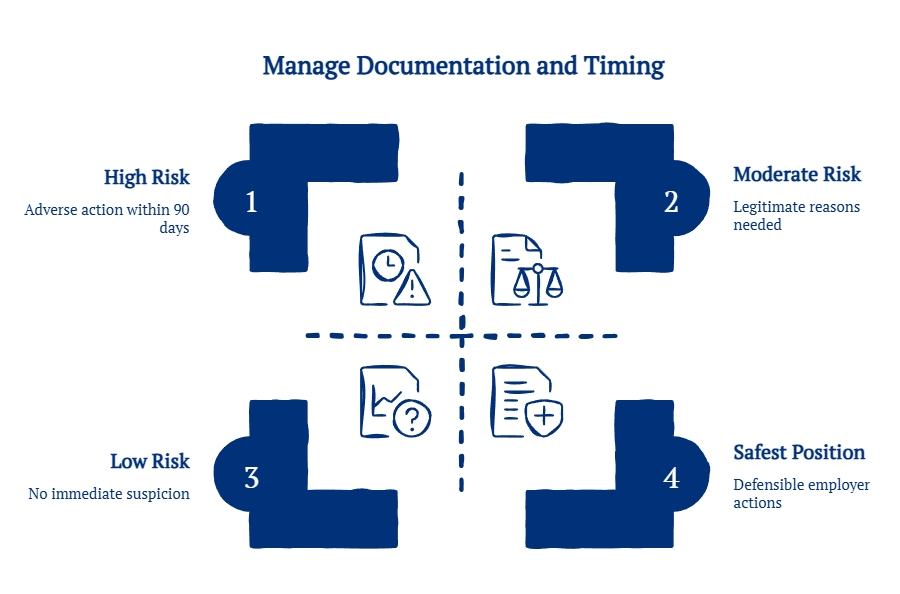
Under the California Equal Pay and Anti-Retaliation Protection Act (SB 497), timing is more than a mere factor; it creates a rebuttable presumption of retaliation. If a restaurant employer takes adverse action, such as termination or demotion, within 90 days of an employee engaging in protected activity, the law now presumes a retaliatory motive. This shifts the initial burden to the employer to prove, by clear and convincing evidence, that the decision was made for legitimate, non-retaliatory reasons. In the fast-paced restaurant environment, this 90-day window effectively converts proximity into a legal hurdle that can be difficult to overcome without airtight, contemporaneous documentation. The same is true when the complaint alleges inconsistent documentation, deviation from stated practice, or materially different explanations from different decision-makers.
For restaurant employers, contemporaneous and consistent documentation often matters because it affects whether the employer’s position appears defensible rather than merely asserted after the fact. Consistent application of established workplace standards may matter for the same reason. When the complaint alleges that one employee was terminated after protected activity while similarly situated employees were treated differently, the dispute may expand well beyond the termination itself and into a broader challenge to the employer’s decision-making process.
Why the Business Impact Can Be Immediate
For Southern California restaurant owners, the impact of these paired claims is compounded by the 2024 PAGA Reform (SB 92/AB 2288). While these lawsuits create immediate operational strain, the potential for staggering civil penalties is now tied directly to the employer’s proactive compliance. Under the reformed Private Attorneys General Act, employers who can demonstrate ‘reasonable steps’—such as periodic payroll audits, updated handbooks, and documented supervisor training—can cap their penalty exposure at 15% to 30%. Conversely, failing to maintain these records in 2026 leaves a restaurant vulnerable to the full weight of representative claims, where penalties are no longer just a ‘cost of business’ but a potential threat to insolvency. In that setting, the pressure comes not only from the legal theories pleaded, but also from the time, cost, and factual complexity those theories may create.
Employment law in this context also functions as a measure of whether the employer’s decision-making appears fair, consistent, and supportable. That is why these disputes often become high-pressure matters for restaurant employers with limited management layers and no in-house counsel.
Disclaimer:
This content is for informational purposes only. Laws, definitions, and deadlines change. Verify current requirements through official California sources. This content is not legal advice. No attorney-client relationship is formed through this content. Please consult a qualified attorney in your jurisdiction for legal advice specific to your situation.
Protect Your Business | The Akopyan Law Firm, A.P.C. | Top Gun Employment Lawyers
Have you been sued by an employee? Are you overwhelmed by the complexities of employment law? If so, give us a call. The Akopyan Law Firm, A.P.C. assists small business owners throughout Southern California. Our seasoned employment defense lawyers stand ready to help employers quickly and efficiently resolve employment disputes. We are ready to aggressively and skillfully defend against any employment case, but understand that in most situations avoiding the expense of litigation is in the client’s best interest.
Take the First Step Protecting Your Future: Call us today to speak with one of our experienced employment lawyers.
Contact Us Today:
- Phone: (818) 509-9975
Office Locations in California: Los Angeles, Bakersfield, Costa Mesa, Temecula, Rancho Cucamonga, Oxnard, Culver City, and San Diego.