

A wrongful termination lawsuit against a Southern California medical practice may reach beyond the employer entity and the termination decision itself. Under California law, generally, a complaint may combine wrongful termination allegations with discrimination, retaliation, whistleblower retaliation, leave-related claims, disability-related claims, reasonable accommodation issues, or public-policy wrongful termination theories. When a plaintiff pleads the case that way, the complaint may also name a practice owner, practice manager, or supervisor as an individual defendant, particularly where allegations of unlawful harassment are involved. While individual supervisors generally cannot be held personally liable for discrimination or retaliation under the Fair Employment and Housing Act (FEHA), they can be held individually liable for harassment. Even when individual liability is legally restricted for certain claims, naming these individuals in the complaint expands the scope of the dispute and increases the burden on a small medical practice.
For closely held medical practices, that issue may carry unusual weight. A small practice often relies on a narrow leadership group, direct owner involvement, and informal internal communications. In that setting, a complaint may place particular attention on the people who participated in discipline, complaint handling, leave discussions, disability-related communications, or the termination decision itself. That concentrated focus may increase litigation burden, management distraction, and operational disruption for a business with limited internal legal infrastructure. The firm’s employer-side materials consistently describe that risk for small Southern California businesses facing active employment disputes.
Why A Wrongful Termination Complaint May Broaden Beyond The Termination Itself
Under California law, generally, wrongful termination is not always pleaded as a single isolated claim. A plaintiff may allege that the termination followed protected activity, whistleblower reporting, a request for job-protected medical leave, a disability-related request for reasonable accommodation, or opposition to conduct the employee believed was unlawful. In some cases, the complaint may use FEHA, California Labor Code section 1102.5, the CFRA, the ADA, or public-policy wrongful termination principles to support allegations about motive, causation, or pretext. That broader pleading may turn a termination case into a dispute about the entire sequence of management conduct that preceded the termination.
Readers seeking related background may also review the firm’s pages on wrongful termination, unlawful retaliation, whistleblower retaliation, reasonable accommodation, and family and medical leave.
Why A Practice Owner, Practice Manager, Or Supervisor May Be Named Individually
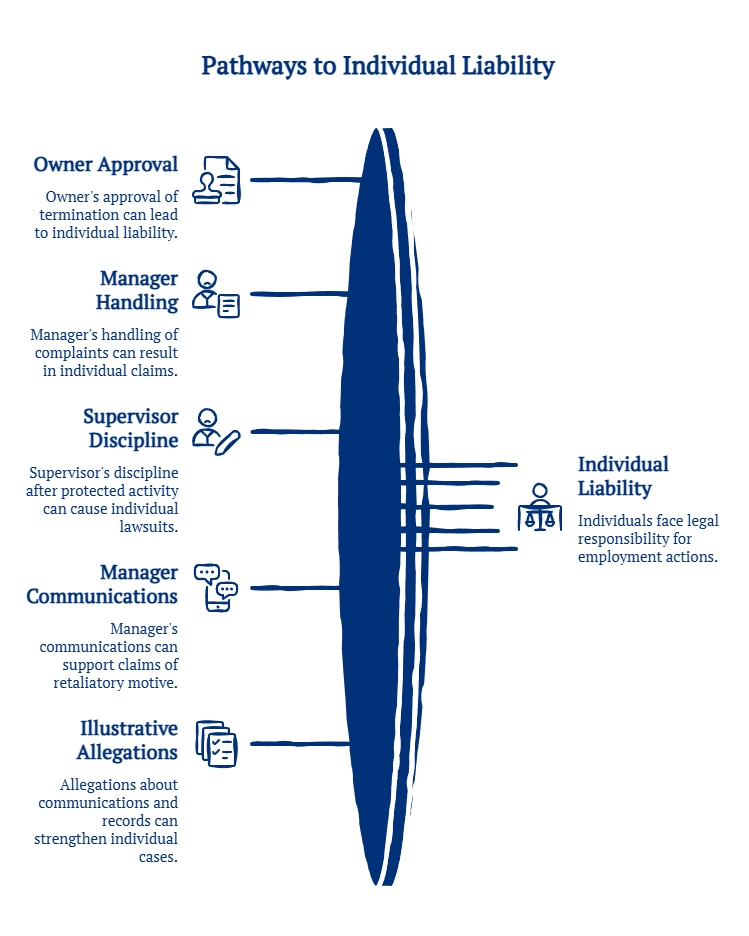
A plaintiff may name an individual defendant to connect a specific person to the alleged adverse employment action and the events surrounding it. In many medical-practice disputes, the complaint may allege that an owner approved the termination, a practice manager handled the employee’s complaint, or a supervisor participated in discipline after protected activity. A plaintiff may also allege that a manager’s statements, emails, text messages, evaluations, or disciplinary write-ups help support an inference of retaliatory motive, discriminatory intent, or pretext. In practice, the complaint may use those facts to place individual conduct at the center of the factual narrative.
Illustrative allegations may involve communications or records such as:
- emails about performance concerns, attendance issues, internal complaints, or staffing pressure;
- text messages among owners, managers, or supervisors about the employee or the disputed events;
- evaluations, disciplinary write-ups, or notes created shortly before termination; or
- comments allegedly tied to protected activity, job-protected medical leave, disability-related accommodation requests, pregnancy-related issues, or whistleblower reporting.
These examples are illustrative only, not exhaustive. Their significance may depend on the legal theory asserted, the role of the individual defendant, and the larger factual record described in the complaint.
Why Claims Against The Employer Entity And Allegations About Individual Conduct Are Not Always The Same
The employer entity and the individual defendant may not occupy the same legal position in every employment case. Some theories focus primarily on the employing business. Other allegations may use a practice owner’s, practice manager’s, or supervisor’s conduct to support a broader theory against the employer entity. Depending on the theory asserted, California law may treat entity exposure and individual exposure differently. That distinction matters because a complaint may rely heavily on individual conduct even when the employer entity remains the principal defendant.
For example, a plaintiff may allege that a supervisor’s conduct supports a harassment claim, or that their response to protected activity provides evidence of the entity’s retaliatory motive. While a manager’s handling of a disability-related request or an owner’s involvement in leave decisions may be scrutinized to establish the employer’s liability for a failure to engage in the interactive process or for wrongful termination, California law generally precludes individual liability for these specific causes of action. In that way, the complaint may use individual conduct to build a case against the practice while attempting to keep individual actors in the litigation through specific counts like harassment or intentional infliction of emotional distress.
Why Small Medical Practices May Face Concentrated Disruption When Individuals Are Named
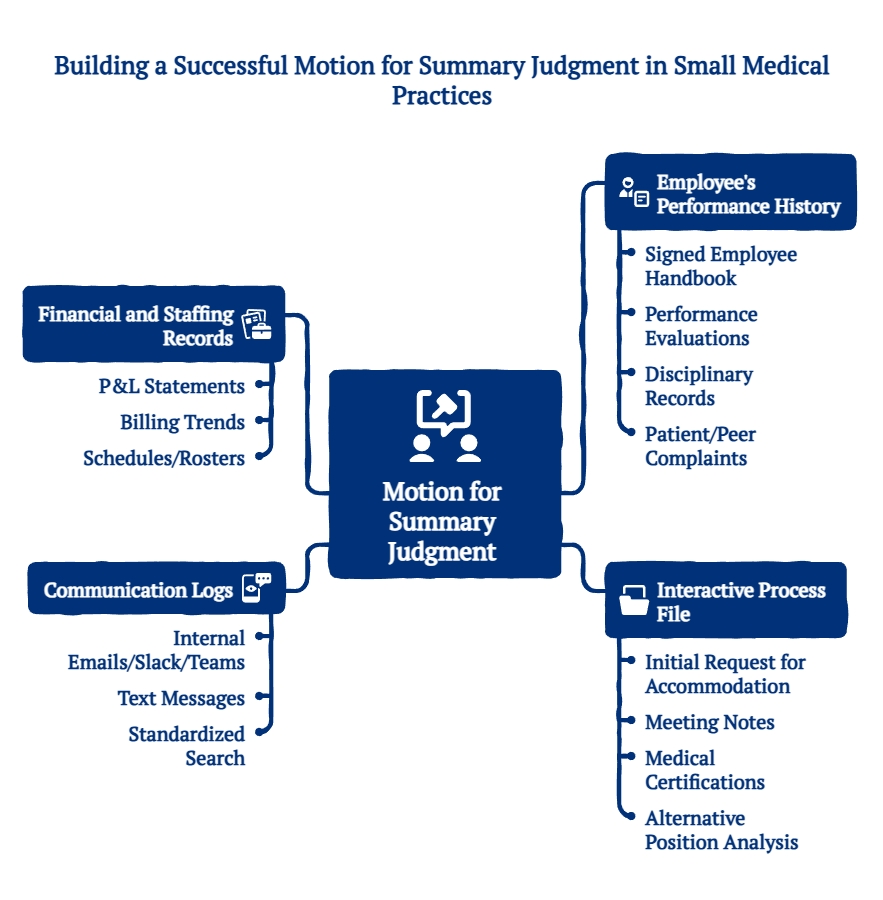
Small Southern California medical practices often have fewer management layers and greater dependence on a core leadership group. Because of this structure, naming individual defendants—such as owners or managers—imposes a unique financial and procedural burden. If a plaintiff refuses to voluntarily dismiss an improperly named individual, the defense must often file a Motion for Summary Judgment (MSJ) to remove them from the case. In California, an MSJ is a high-stakes, labor-intensive procedural tool that requires extensive legal research, the drafting of separate statements of undisputed facts, and the preparation of supporting declarations. The legal fees associated with an MSJ can be substantial, often representing a significant portion of the overall defense budget. Beyond these costs, the process demands heavy involvement from the named individuals for depositions and evidence gathering, creating a dual strain: a drain on the practice’s financial resources and a direct disruption to day-to-day patient care and operations.
To build a successful Motion for Summary Judgment (MSJ) in California, your attorney must prove that there is “no triable issue of material fact”—essentially, that even if the court believes the plaintiff’s version of events, the law still requires the case to be dismissed.
For a small medical practice, this relies entirely on the paper trail. Here is a checklist of critical internal documents you should organize immediately to minimize legal fees and maximize the chances of a successful dismissal:
- The Employee’s Performance History
The goal here is to establish a Legitimate, Non-Discriminatory Reason (LNDR) for the termination that predates any “protected activity” (like a whistleblower complaint or a leave request).
- Signed Acknowledgment of Employee Handbook: Proves the employee knew the rules they allegedly broke.
- Performance Evaluations: Both formal and informal. Note: Inconsistent reviews (e.g., “Good” ratings right before a firing) are a common “Low Confidence” area for defense.
- Disciplinary Records: Written warnings, “Performance Improvement Plans” (PIPs), and notes from verbal counseling sessions.
- Patient or Peer Complaints: Emails or written statements from third parties that support the practice’s decision.
- The “Interactive Process” File (Disability/Medical)
If the claim involves disability or medical leave (CFRA/FMLA), this is the most scrutinized set of documents. You must prove the practice engaged in a timely, good-faith “interactive process.”
- Initial Request for Accommodation: Any email, text, or note where the employee mentioned a medical need.
- Meeting Notes: Contemporaneous notes from every discussion regarding work restrictions or leave dates.
- Medical Certifications: Correspondence from the employee’s healthcare provider (ensuring HIPAA-compliant handling).
- Alternative Position Analysis: Documents showing you looked for other roles if the employee couldn’t perform their current job.
- Communication Logs (The “Digital Smoke”)
Plaintiffs’ attorneys like “stray remarks” in informal communications. You need to gather these first to give your attorney a head start on “damage control” or context-building.
- Internal Emails/Slack/Teams: Specifically, between the named individual defendants (owners/managers) discussing the employee.
- Text Messages: If your managers use personal phones for work, these must be preserved.
- Fact Checker Tip: Standardize your search by using key dates (e.g., two weeks before and after the termination) to ensure you aren’t missing “hot” documents that the plaintiff might already have.
- Financial and Staffing Records
If the defense is “Restructuring” or “Budget Cuts,” these documents are your primary evidence.
- P&L Statements or Billing Trends: Showing a downturn that necessitated staffing changes.
- Schedules/Rosters: To prove that the “replacement” the plaintiff claims you hired was actually an existing employee or a different role entirely.
Disclaimer:
This content is for informational purposes only. Laws, definitions, and deadlines change. Verify current requirements through official California sources. This content is not legal advice. No attorney-client relationship is formed through this content. Please consult a qualified attorney in your jurisdiction for legal advice specific to your situation.
Protect Your Business | The Akopyan Law Firm, A.P.C. | Top Gun Employment Lawyers
Have you been sued by an employee? Are you overwhelmed by the complexities of employment law? If so, give us a call. The Akopyan Law Firm, A.P.C. assists small business owners throughout Southern California. Our seasoned employment defense lawyers stand ready to help employers quickly and efficiently resolve employment disputes. We are ready to aggressively and skillfully defend against any employment case, but understand that in most situations avoiding the expense of litigation is in the client’s best interest.
Take the First Step Protecting Your Future: Call us today to speak with one of our experienced employment lawyers.
Contact Us Today:
- Phone: (818) 509-9975
Office Locations in California: Los Angeles, Bakersfield, Costa Mesa, Temecula, Rancho Cucamonga, Oxnard, Culver City, and San Diego.