

📌 Key Takeaways
Wrongful termination claims against California medical practices may expand quickly because damages exposure often reaches beyond the termination decision itself.
- Damages Often Multiply: A plaintiff may seek back pay, front pay, attorney’s fees, and, in some cases, punitive damages in the same dispute.
- Back Pay Drives Exposure: Alleged lost wages, bonuses, incentive pay, and other earnings may give the claim immediate economic weight.
- Front Pay Raises Stakes: Alleged future economic loss may extend the dispute beyond past compensation and increase the claimed seriousness of the case.
- Fee Exposure Changes Economics: Attorney’s fees may make even a single-plaintiff case financially significant for a small or closely held medical practice.
- Protected Activity Broadens Claims: Allegations involving job-protected leave, disability, accommodation, or whistleblower activity may widen both the factual dispute and the damages picture.
In wrongful termination litigation, the claimed damages often grow as the factual narrative grows.
California medical practice owners and administrators facing active employment disputes will gain a clearer view of potential exposure here, guiding them into the damages-specific details that follow.
~ ~ ~ ~ ~ ~ ~ ~ ~ ~ ~ ~ ~ ~ ~ ~ ~ ~
While often used as a broad descriptor, a ‘Wrongful Termination in Violation of Public Policy’ (also known as a Tameny claim) is a specific common law tort in California. It is frequently litigated alongside statutory claims brought under FEHA or the Labor Code. While these claims overlap factually, they are legally distinct: statutory claims provide specific remedies like attorney’s fees and administrative exhaustion requirements, whereas a Tameny claim is rooted in fundamental public policies established in constitution or statute.
That broader theory matters because it may increase both the number of disputed issues and the categories of damages the plaintiff seeks to recover. For a small medical practice, the result may be a more expensive and operationally disruptive dispute than the termination decision alone would suggest.
Back Pay Often Anchors the Plaintiff’s Economic Damages Theory
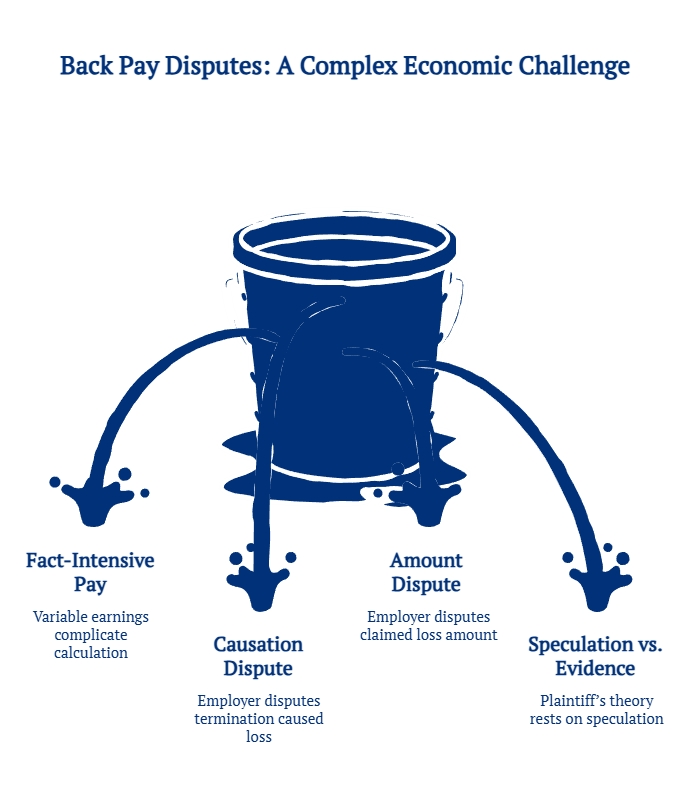
Back pay generally refers to alleged past economic loss following termination. Depending on the claims asserted, a plaintiff may seek wages, compensation, bonuses, or other earnings the plaintiff contends would have been received if the employment relationship had continued. In a medical practice, that issue may become fact-intensive because pay may include hourly wages, variable schedules, production-based compensation, incentive pay, or other forms of earnings that are not captured by base pay alone.
The parties may dispute several issues at the same time. A plaintiff may argue that the termination caused lost pay. The employer may dispute whether the claimed loss was caused by the termination, whether the amount is supported by the record, or whether the plaintiff’s earnings theory rests on speculation rather than evidence.
That damages category often becomes central early in the case because alleged past wage loss gives the complaint an immediate economic dimension. Even where liability is contested, a back pay claim may shape settlement pressure, litigation cost, and the overall seriousness of the dispute.
Front Pay May Extend the Dispute into Alleged Future Economic Loss
Front pay differs from back pay because it concerns alleged future economic loss rather than past earnings. In some California employment cases, a plaintiff may seek front pay where reinstatement is not at issue or is not realistically available. A front pay claim may therefore extend the damages theory beyond the date of termination and into an alleged future period of lost compensation.
That theory may become significant where the plaintiff alleges that the termination affected future employment prospects, future earnings, or longer-term professional stability. The employer may dispute whether the plaintiff has shown a factual basis for future loss, whether the alleged future harm is too uncertain, or whether the claimed period of loss is supported by the record.
For the employer, the practical implication is clear. A case that begins as a dispute over past wages may become a broader dispute over alleged long-term economic consequences, which may increase the claimed value and complexity of the case.
Attorney’s Fees May Materially Change the Economics of the Case
Attorney’s fees often represent the most significant financial risk in California employment litigation due to ‘one-way’ fee-shifting statutes. Under the Fair Employment and Housing Act (FEHA) and various Labor Code sections (e.g., § 1102.5), a prevailing plaintiff is generally entitled to recover reasonable attorney’s fees. Critically for the employer, a prevailing defendant can typically only recover fees if they prove the plaintiff’s claim was frivolous, unreasonable, or groundless—a much higher legal bar. Consequently, the potential for a six-figure fee award can dwarf the underlying wage dispute, particularly in single-plaintiff cases involving extensive discovery or motion practice.
This issue often matters for small and closely held medical practices because a single-plaintiff case may still require substantial attorney time, document review, written discovery, depositions, motion practice, and expert analysis. When fee-shifting is potentially available, the financial significance of the dispute may no longer depend only on back pay or front pay allegations.
In practical terms, attorney’s fees exposure may increase litigation pressure independently of the underlying employment decision. That is one reason a wrongful termination case may become financially significant even when the dispute initially appears narrow.
Punitive Damages Exposure May Arise in Cases Involving Serious Allegations
Punitive damages often receive outsized attention because they carry unusual financial and reputational weight. Under California law, punitive damages are not automatic in employment litigation. Depending on the claim and the evidentiary record, a plaintiff may attempt to pursue punitive damages by alleging conduct the law treats as sufficiently serious, including malice, oppression, or fraud.
A plaintiff may attempt to support that theory through internal emails, text messages, inconsistent explanations, comparator evidence, or facts the plaintiff argues show that the employer’s stated reason for termination was pretextual rather than genuine and motivated by malice, oppression or fraud. In a closely held medical practice, the complaint may focus closely on the actions and communications of owners, partners, physicians in leadership, practice administrators, or senior managers if the plaintiff alleges direct involvement in the challenged decision.
That issue matters because punitive exposure can change how the case is perceived inside and outside the business. Even where punitive damages are contested, the allegation alone may intensify reputational concern, discovery demands, and the overall stakes of the litigation.
Protected Activity and Protected Status Allegations May Broaden the Case
Wrongful termination cases often expand when the plaintiff alleges that the termination followed protected activity or involved a protected status. A plaintiff may allege, for example, that job-protected leave was followed by disciplinary write-ups, reduced hours, or termination. A plaintiff may allege that a request for reasonable accommodation, a disability-related discussion, a protected internal complaint, or whistleblower activity was followed by adverse action. In that setting, the sequence of events may become central to the dispute because timing may be used to support an inference of retaliatory or discriminatory motivation.
A complaint may therefore combine wrongful termination with unlawful retaliation, whistleblower retaliation, disability discrimination, or family medical leave claims. The legal significance of those allegations is not merely descriptive. Those allegations may increase the number of disputed facts, enlarge the remedies asserted, and place greater emphasis on causation, protected conduct, and pretext.
For the employer, that means a termination case may quickly become a broader employment case. The dispute may no longer turn only on whether the employer had a stated reason for termination. The dispute may also turn on whether a trier of fact concludes that protected activity, protected leave status, disability, or another protected characteristic played a role in the decision.
Small Medical Practices Often Face Distinct Operational Disruption
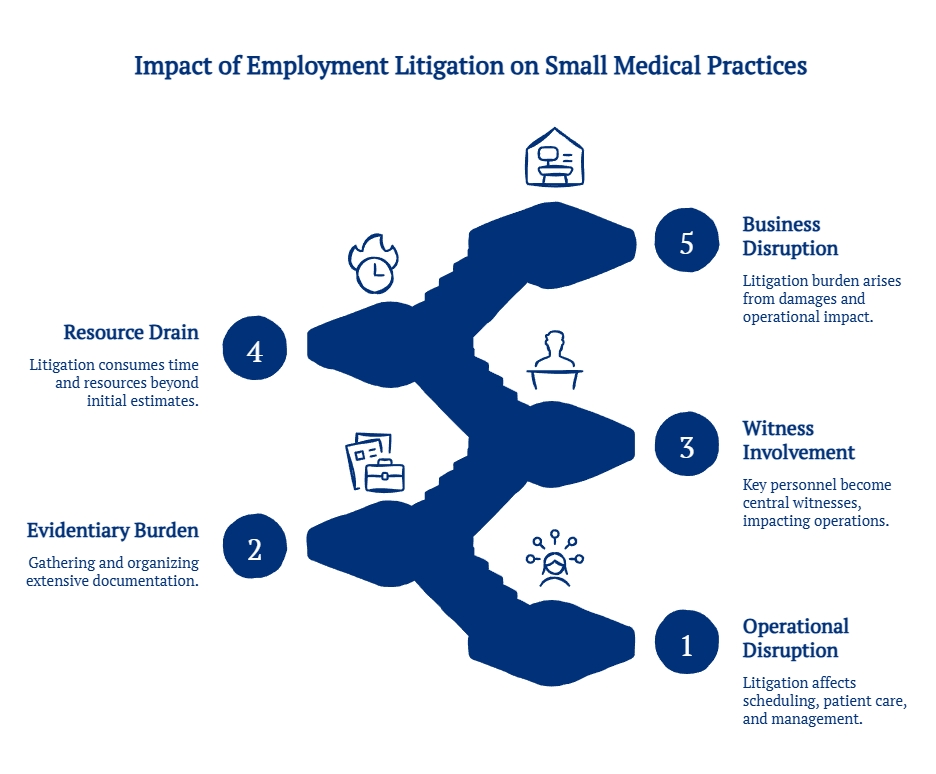
Medical practices often operate with lean staffing, close supervisory structures, and substantial operational interdependence. Because of that structure, employment litigation may affect more than legal expense. A wrongful termination case may also affect scheduling, patient-facing responsibilities, management attention, and internal workplace dynamics while the matter remains pending.
The evidentiary burden may also be substantial. Depending on the allegations, the record may include personnel files, payroll records, performance evaluations, disciplinary write-ups, internal emails, text messages, schedules, and communications among supervisors, administrators, owners, or partners. In a small practice, the same individuals who made staffing decisions may also become central witnesses, which may increase disruption to day-to-day operations.
That operational overlap matters because even a single-plaintiff case may consume time and resources far beyond what the initial complaint suggests. For a closely held medical practice, litigation burden may therefore arise both from potential damages and from the business disruption required to defend the case.
The Stated Reason for Termination May Become a Central Evidentiary Issue
Many wrongful termination cases turn on whether the employer’s stated reason for termination is accepted as legitimate or challenged as pretext. A plaintiff may rely on timing, shifting explanations, comparator treatment, internal messages, positive evaluations followed by sudden discipline, or other surrounding facts to argue that the stated reason was not the actual motivation for the decision. The employer may contend that the termination was based on a legitimate business reason or a legitimate nondiscriminatory reason.
That dispute often becomes central because a trier of fact may be asked to evaluate not only the decision itself, but also the consistency of the employer’s explanation and the surrounding record. When the plaintiff frames the evidence as showing retaliation, discrimination, or another unlawful motive, the claimed damages exposure may become intertwined with the broader factual narrative.
The implication for the reader is straightforward. In wrongful termination litigation, damages exposure is often shaped not only by the termination decision, but also by how the surrounding facts are characterized and contested.
Why Prompt Legal Evaluation Matters in Active Wrongful Termination Disputes
For a small Southern California medical practice, even one wrongful termination claim may become financially and operationally significant. Back pay, front pay, attorney’s fees, and possible punitive damages may combine with retaliation, whistleblower retaliation, disability, accommodation, job-protected leave, harassment, or public-policy allegations to broaden the case considerably.
Because these matters are fact-specific, legally complex, and procedurally significant, prompt evaluation by a qualified employment defense attorney is often critical. The applicable law, the claims asserted, the procedural posture, and the underlying factual record may all affect exposure in ways that are difficult to assess from the complaint alone.
Disclaimer:
This content is for informational purposes only. Laws, definitions, and deadlines change. Verify current requirements through official California sources. This content is not legal advice. No attorney-client relationship is formed through this content. Please consult a qualified attorney in your jurisdiction for legal advice specific to your situation.
Protect Your Business | The Akopyan Law Firm, A.P.C. | Top Gun Employment Lawyers
Have you been sued by an employee? Are you overwhelmed by the complexities of employment law? If so, give us a call. The Akopyan Law Firm, A.P.C. assists small business owners throughout Southern California. Our seasoned employment defense lawyers stand ready to help employers quickly and efficiently resolve employment disputes. We are ready to aggressively and skillfully defend against any employment case, but understand that in most situations avoiding the expense of litigation is in the client’s best interest.
Take the First Step Protecting Your Future: Call us today to speak with one of our experienced employment lawyers.
Contact Us Today:
- Phone: (818) 509-9975
- Office Locations in California: Los Angeles, Bakersfield, Costa Mesa, Temecula, Rancho Cucamonga, Oxnard, Culver City, and San Diego.