
For Southern California medical practices already facing a retaliation-based wrongful termination dispute, California’s SB 497 (Equal Pay and Anti-Retaliation Act), effective January 1, 2024, may materially affect how timing is viewed in litigation. Under specified Labor Code provisions, an adverse employment action taken within 90 days of protected activity may trigger a rebuttable presumption in favor of the employee’s claim. In a wrongful termination case, that timing issue may increase scrutiny of causation, pretext, internal communications, and the employer’s stated reasons for the decision.
What SB 497 Changed in California Retaliation Law
SB 497 (Equal Pay and Anti-Retaliation Act), effective January 1, 2024, amended California Labor Code sections 98.6, 1102.5, and 1197.5. The statute added a 90-day rebuttable presumption to sections 98.6 and 1197.5 when the statutory conditions are met. While the text of SB 497 specifically inserted the 90-day presumption language into sections 98.6 and 1197.5, its practical application frequently encompasses whistleblower claims under section 1102.5 as well. Because section 98.6 prohibits retaliation for the exercise of ‘any rights’ afforded by the Labor Code—and section 1102.5 is a foundational Labor Code right—courts and the Labor Commissioner generally apply the rebuttable presumption to whistleblower reports. (See Cal. Lab. Code § 98.6(b)(1); Ogletree Deakins, 2024 Legal Update). For a medical practice, this means the 90-day window should be viewed as a high-risk period for nearly all retaliation-based theories.
At a general level, a rebuttable presumption gives legal significance to timing under the statutes that contain it. When a complaint alleges protected activity followed by an adverse employment action within that 90-day period, the employer may face more concentrated scrutiny of whether the stated reason for the decision was genuine or instead may be characterized as pretext. In practical terms, the statute can make a short chronology more consequential in litigation than it would have been before.
Why the 90-Day Presumption Can Affect a Wrongful Termination Case
A retaliation claim and a wrongful termination claim often appear in the same complaint. A plaintiff may allege that protected activity occurred first, that termination followed, and that the sequence supports an inference of retaliatory motive. Once that theory is pleaded, the case often extends beyond the termination decision itself.
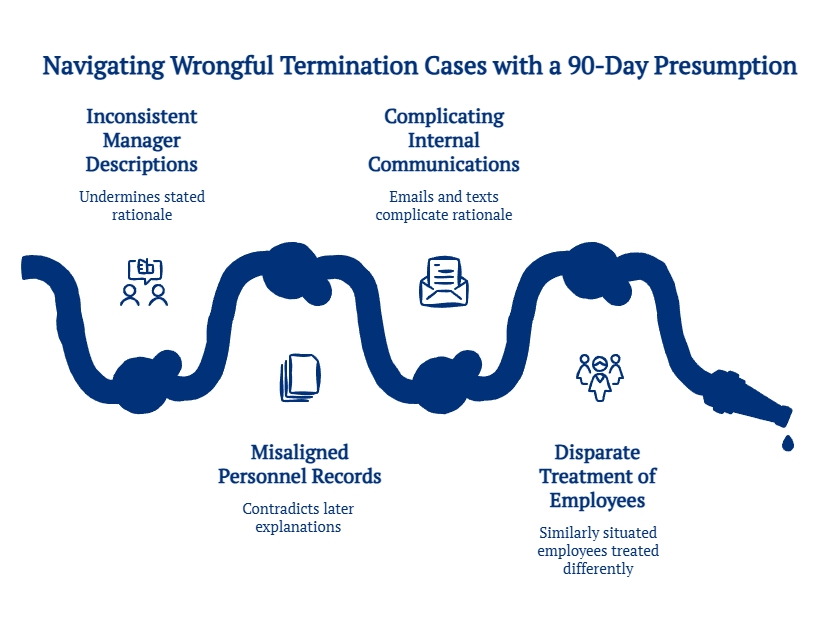
The litigation may then turn on familiar employer-side issues: whether managers described the decision consistently, whether the personnel record aligns with later explanations, whether internal emails or text messages complicate the stated rationale, and whether similarly situated employees were treated differently. A 90-day rebuttable presumption does not decide the case by itself, but it may make causation and pretext more central from the outset. For a Southern California medical practice already confronting a filed claim, that can increase both complexity and exposure.
Why Medical Practices May Face Heightened Exposure
Small medical practices often operate through close supervision, lean staffing, and frequent day-to-day communication among owners, practice administrators, lead clinicians, and supervisors. That structure can produce overlapping records, informal communications, and multiple decision-makers tied to the same employment event. In litigation, those features may make chronology and internal consistency especially important.
Medical-practice disputes also tend to arise in settings where a plaintiff may frame one sequence of events through several legal theories at once. A termination may be linked to alleged unlawful retaliation, a wage-related complaint, an internal report, a leave issue, or a protected objection to workplace conduct. The result is not that every medical practice termination implicates SB 497. The result is that when protected activity under an amended statute is alleged and termination follows quickly, the practice may face a more difficult litigation posture than the underlying employment decision initially suggested.
How Retaliation Allegations May Overlap with Wrongful Termination Pleadings
California employment complaints often combine statutory retaliation claims with broader wrongful termination theories. A plaintiff may contend that management’s conduct changed after protected activity, that discipline intensified, or that the employer moved toward separation only after the employee engaged in conduct protected by statute. The wrongful termination claim may then serve as a broader narrative vehicle for the same alleged retaliatory sequence.
That overlap matters because plaintiffs’ counsel often tests the entire record, not just the final decision. Performance evaluations, disciplinary write-ups, scheduling changes, pay-related communications, supervisor emails, and internal discussions may all be examined for inconsistency or signs of retaliatory motive. Where the complaint also includes whistleblower retaliation allegations or other statutory theories, the dispute may become even more complex. For the employer, the significance of SB 497 is therefore not limited to statutory wording. The statute may alter how the timing of the case is argued and how the surrounding record is interpreted.
Why Timing, Documentation, and Internal Consistency Become Central
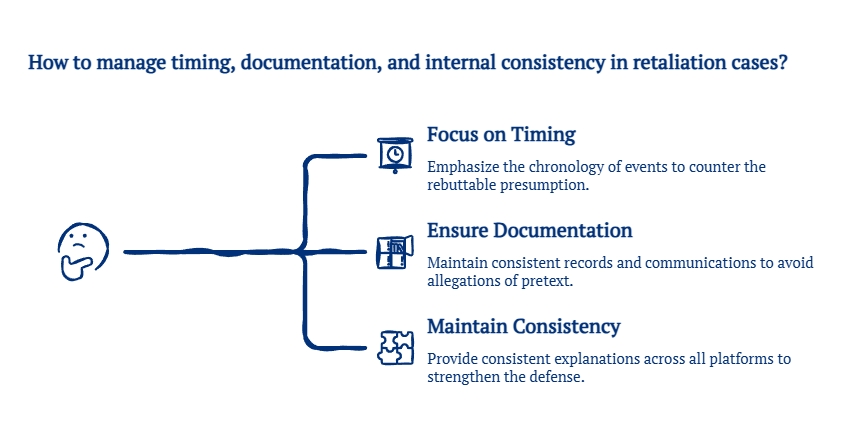
Timing alone does not establish liability. Even so, timing may take on greater evidentiary significance when a rebuttable presumption is alleged under a statute that contains one. In that setting, the employer’s chronology may become a central issue in the case.
Documentation matters for the same reason. The question is not merely whether records exist. The question is whether the employer’s records, communications, and explanations remain consistent across the personnel file, internal messages, witness accounts, and the chronology alleged in the complaint. A plaintiff may use gaps, shifts in explanation, or inconsistent treatment to argue pretext. An employer may dispute those allegations, but the dispute itself often becomes more difficult when protected activity and termination are close in time.
An illustrative example shows the point. A medical-practice employee engages in protected activity under an amended Labor Code provision, and the employee is terminated within a short period. The complaint alleges retaliation and wrongful termination and argues that the sequence supports a causal connection. In that circumstance, the litigation may focus heavily on whether the employer’s explanation appears consistent across the full record.
Why Immediate Legal Review Matters in Active Employment Disputes
When a medical practice is already facing a lawsuit, agency complaint, or similar legal filing, prompt review by a qualified employment defense lawyer may be critical. Employment defendants typically face strict response obligations, and delay may create serious consequences, including default judgment, sanctions, or expanded exposure.
Disclaimer:
This content is for informational purposes only. Laws, definitions, and deadlines change. Verify current requirements through official California sources. This content is not legal advice. No attorney-client relationship is formed through this content. Please consult a qualified attorney in your jurisdiction for legal advice specific to your situation.
Protect Your Business | The Akopyan Law Firm, A.P.C. | Top Gun Employment Lawyers
Have you been sued by an employee? Are you overwhelmed by the complexities of employment law? If so, give us a call. The Akopyan Law Firm, A.P.C. assists small business owners throughout Southern California. Our seasoned employment defense lawyers stand ready to help employers quickly and efficiently resolve employment disputes. We are ready to aggressively and skillfully defend against any employment case, but understand that in most situations avoiding the expense of litigation is in the client’s best interest.
Take the First Step Protecting Your Future: Call us today to speak with one of our experienced employment lawyers.
Contact Us Today:
- Phone: (818) 509-9975
Office Locations in California: Los Angeles, Bakersfield, Costa Mesa, Temecula, Rancho Cucamonga, Oxnard, Culver City, and San Diego.