

📌 Key Takeaways
At-will employment in California may define the employment relationship, but it does not automatically defeat a wrongful-termination claim.
- At-Will Has Limits: California Labor Code section 2922 may establish a default rule, yet a plaintiff may still allege unlawful motivation behind a termination.
- Overlapping Claims Expand Exposure: A single termination may be alleged to involve discrimination, retaliation, job-protected medical leave, whistleblower conduct, or public-policy wrongful termination.
- Facts Often Drive Liability: A judge, jury, or other trier of fact may focus on timing, communications, disciplinary records, and comparative treatment, not only the at-will doctrine.
- Protected Conduct Matters: A protected complaint, a job-protected medical leave request, or accommodation discussions may become central when a plaintiff alleges causal connection or pretext.
- Small Businesses Face Early Strain: Small businesses such as medical practices may confront management distraction, increased legal expenses, and broader exposure once overlapping claims are asserted.
At-will status may set the background, but alleged unlawful motivation may define the case.
California business owners and medical practice leaders facing wrongful-termination exposure will gain immediate clarity here, guiding them into the employer-side details that follow.
~ ~ ~ ~ ~ ~ ~ ~ ~ ~ ~ ~ ~ ~ ~ ~ ~ ~
At-will employment under California law is a default rule, not a categorical shield against wrongful-termination liability. California Labor Code section 2922 generally allows an employer or an employee to end the employment relationship at any time, with or without cause. That rule, however, does not automatically defeat a wrongful-termination claim. A plaintiff may still allege that a termination violated the law because it was connected to protected status, protected activity, job-protected medical leave, disability-related issues, whistleblower conduct, or public-policy concerns. For small businesses and medical practices, that distinction may turn a termination that management viewed as routine into litigation involving overlapping statutory and common-law claims.
Why At-Will Employment Does Not Create Immunity Under California Law
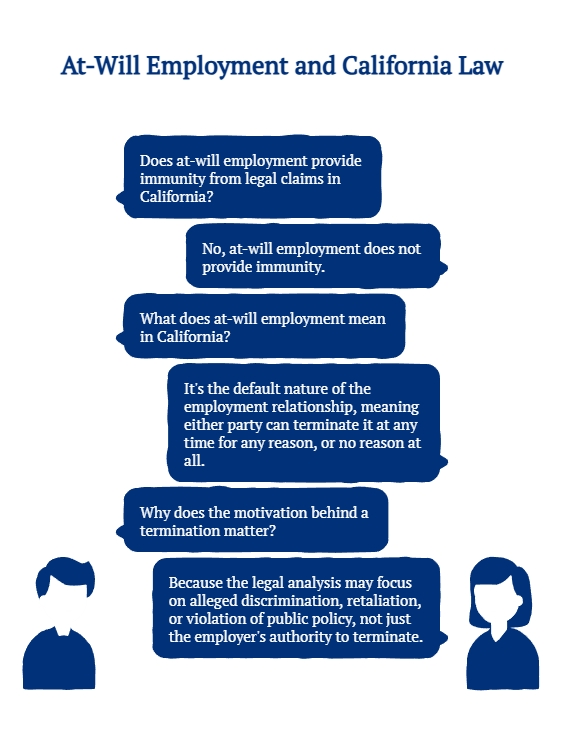
Under California law, generally, at-will employment describes the default nature of the employment relationship. It does not provide immunity from claims arising under statutes or common law. An employer may view a termination as a business decision supported by operational or performance concerns, while the plaintiff may allege that the same termination was motivated by discrimination, retaliation, or a violation of public policy.
That distinction matters because the legal analysis often does not stop with the employer’s authority to terminate. The dispute may instead focus on alleged motivation, the sequence of events, and whether protected circumstances may have contributed to the decision.
Why At-Will Employment May Not Defeat Overlapping Wrongful-Termination Claims
Many wrongful-termination cases involve more than one claim. A single termination may be alleged to implicate the California Fair Employment and Housing Act, retaliation statutes, leave-related protections, whistleblower protections, and public-policy wrongful termination. In that setting, at-will employment remains part of the legal background, but it may not resolve the case.
A plaintiff may attempt to show that the employer’s stated reason was pretext. In practical terms, pretext usually refers to an allegation that the stated reason does not match the surrounding facts, was applied inconsistently, or changed over time. A plaintiff may also attempt to show a causal connection between protected conduct and the termination. In many cases, that means the plaintiff alleges that a protected complaint, a job-protected medical leave request, a disability-related discussion, or a report about wages or safety was followed by discipline or termination.
Related allegations may appear alongside claims involving unlawful workplace retaliation, whistleblower retaliation, or broader wrongful termination exposure. As a result, reliance on at-will employment alone may not address the full scope of the plaintiff’s allegations.
Why the Facts Surrounding Termination Often Matter as Much as the Termination Itself
In many wrongful-termination disputes, the termination itself becomes only one part of the factual record. The plaintiff may focus on what happened before the termination, what was said during the relevant period, and how other employees were treated in comparable circumstances.
Typical areas of scrutiny may include:
- performance evaluations, including whether the employee previously received positive evaluations before later disciplinary write-ups appeared
- disciplinary records, including whether the employer documented concerns consistently over time
- internal emails, text messages, and other electronic communications created by supervisors or managers
- complaints involving discrimination, harassment, wages, or workplace safety
- job-protected medical leave requests, return-to-work issues, and medical leave status
- reasonable accommodation and interactive process discussions; and
- the treatment of similarly situated employees.
A judge, jury, or other trier of fact may evaluate whether those facts are consistent with the employer’s stated reason for the termination. For an employer, that means the dispute may turn less on the phrase “at-will” and more on whether the surrounding record appears consistent, neutral, and lawfully motivated.
Why Timing, Communications, and Comparative Treatment May Support a Plaintiff’s Theory
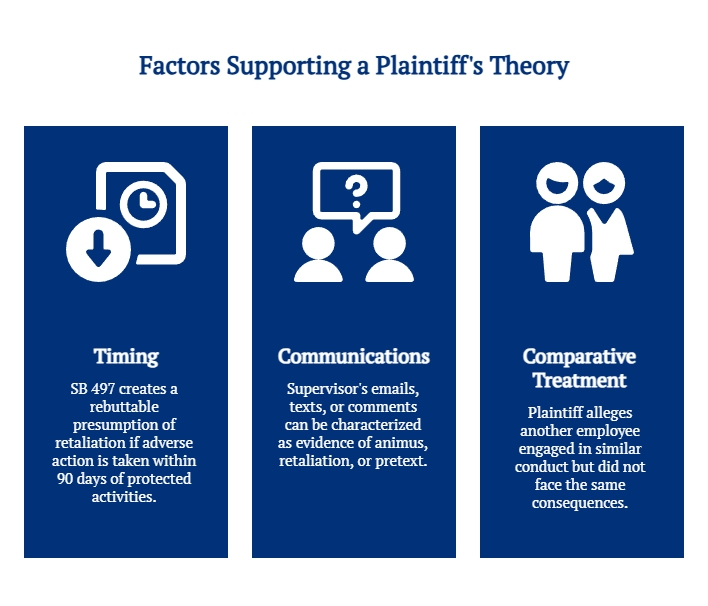
Timing is no longer merely a circumstantial factor; under California’s SB 497 (The Equal Pay and Anti-Retaliation Protection Act), there is now a rebuttable presumption of retaliation if an employer takes adverse action against an employee within 90 days of certain protected activities, such as reporting wage theft or unequal pay. This shifts the initial burden of proof to the employer to provide a legitimate, non-retaliatory reason for the termination, significantly complicating the defense of an at-will termination during that window. For example, a request for job-protected medical leave may be followed by write-ups, reduced hours, or termination, and the plaintiff may rely on that sequence to argue that the stated business reason was not the actual motivation.
Communications may also become important when a supervisor’s email, text message, or informal comment is later characterized as evidence of animus, retaliation, or pretext. Comparative treatment may matter when a plaintiff alleges that another employee engaged in similar conduct but did not face the same consequences.
Plaintiffs often rely on circumstantial evidence rather than direct admissions. In that scenario, the employer’s explanation, the chronology, and the consistency of management’s actions may become central to the case.
How Leave, Accommodation, Retaliation, and Whistleblower Issues May Change the Legal Analysis
Protected leave and disability-related issues often change the legal analysis of a termination. California law provides robust protections under the California Family Rights Act (CFRA), which applies to all employers with five or more employees. Many small medical practices or boutique offices that were historically exempt from federal FMLA requirements now fall under CFRA’s mandate. Consequently, a termination involving an employee at a practice with as few as five employees can trigger claims of leave interference or failure to reinstate, regardless of the employee’s at-will status.
Related issues may overlap with family medical leave disputes or reasonable accommodation claims. Retaliation and whistleblower issues may follow a similar pattern. An employee who complained about suspected legal violations, workplace safety, wage practices, or other protected matters may later allege that the termination was retaliatory. These examples are illustrative, not exhaustive, and the legal significance of any allegation depends on the claims asserted and the facts at issue.
Why Small Medical Practices Often Misjudge the Limits of At-Will Employment
Small medical practices often operate with lean leadership structures, limited administrative support, and no in-house employment counsel. In that environment, at-will employment may be treated as shorthand for broad termination authority. California law may treat the issue more narrowly once a plaintiff alleges unlawful motivation.
A small medical office, dental practice, veterinary clinic, urgent care operation, or med spa may face scrutiny of supervisor communications, scheduling decisions, leave-related discussions, and past treatment of other employees. That scrutiny may shift management attention away from operations, increase legal expenditure, and expand the scope of the dispute beyond the employer’s initial view of the termination. For closely held businesses, the practical burden may arise early, even before the underlying claims are resolved.
Why Active Wrongful-Termination Allegations Commonly Require Prompt Evaluation by Employment Defense Lawyer
At-will employment remains an important legal principle, but it often does not end the analysis once a plaintiff alleges discrimination, retaliation, interference with job-protected medical leave, accommodation failures, whistleblower retaliation, or wrongful discharge in violation of public policy. For California employers, especially small medical practices, the more significant question is often whether the plaintiff may be able to connect the termination to protected status or protected activity. When that kind of claim is asserted, the dispute may extend well beyond the employer’s original understanding of the termination and requires evaluation from experienced employment defense attorneys in Southern California.
Disclaimer:
This content is for informational purposes only. Laws, definitions, and deadlines change. Verify current requirements through official California sources. This content is not legal advice. No attorney-client relationship is formed through this content. Please consult a qualified attorney in your jurisdiction for legal advice specific to your situation.
Protect Your Business | The Akopyan Law Firm, A.P.C. | Top Gun Employment Lawyers
Have you been sued by an employee? Are you overwhelmed by the complexities of employment law? If so, give us a call. The Akopyan Law Firm, A.P.C. assists small business owners throughout Southern California. Our seasoned employment defense lawyers stand ready to help employers quickly and efficiently resolve employment disputes. We are ready to aggressively and skillfully defend against any employment case, but understand that in most situations avoiding the expense of litigation is in the client’s best interest.
Take the First Step Protecting Your Future: Call us today to speak with one of our experienced employment lawyers.
Contact Us Today:
- Phone: (818) 509-9975
Office Locations in California: Los Angeles, Bakersfield, Costa Mesa, Temecula, Rancho Cucamonga, Oxnard, Culver City, and San Diego.