

In many Southern California employment disputes, a plaintiff may challenge one termination through multiple causes of action. A complaint may allege wrongful termination and allege discrimination under the Fair Employment and Housing Act, or FEHA. Those claims may arise from the same discharge, but the law treats them as distinct legal theories.
That distinction matters because each theory may require a different legal analysis. A wrongful termination claim may assert that the discharge violated statutory protection or public policy. A FEHA discrimination claim may assert that a protected characteristic affected the employer’s decision. When a plaintiff pleads both theories together, the dispute may become broader, more fact-intensive, and more expensive for the medical practice to defend.
What a FEHA Discrimination Claim Generally Alleges
FEHA prohibits discrimination based on protected characteristics for employers who regularly employ five or more persons (Gov. Code, § 12926, subd. (d)). While harassment prohibitions apply to all employers regardless of size, a statutory discrimination claim generally requires this five-employee threshold. In many Southern California medical practices—particularly those that are growing—meeting this headcount subjects the practice to the full scope of FEHA’s administrative and litigation requirements. For very small practices with fewer than five employees, while they may be exempt from statutory FEHA discrimination claims, they may still face ‘Tameny’ claims for wrongful termination in violation of public policy if the discharge contravenes a fundamental policy rooted in the constitution or other statutes (see Tameny v. Atlantic Richfield Co. (1980) 27 Cal.3d 167).
Depending on the facts, the protected characteristic may involve disability, pregnancy, sex, race, age, religion, reproductive health decision-making, or another category recognized by California law (Gov. Code, § 12940, subd. (a)).
A FEHA discrimination claim focuses more directly on discriminatory motive and causation. A plaintiff may allege not only that the termination was unlawful, but also that the employer acted because of a protected characteristic. That allegation may place added attention on whether the employer can articulate a legitimate nondiscriminatory reason and whether the plaintiff alleges pretext. Related background appears in the firm’s employer-side materials on disability discrimination and reasonable accommodation. For an employer facing an active dispute, the FEHA claim may expand both the legal issues and the factual questions in the case.
Why One Termination in Medical Practice May Lead to Multiple Claims
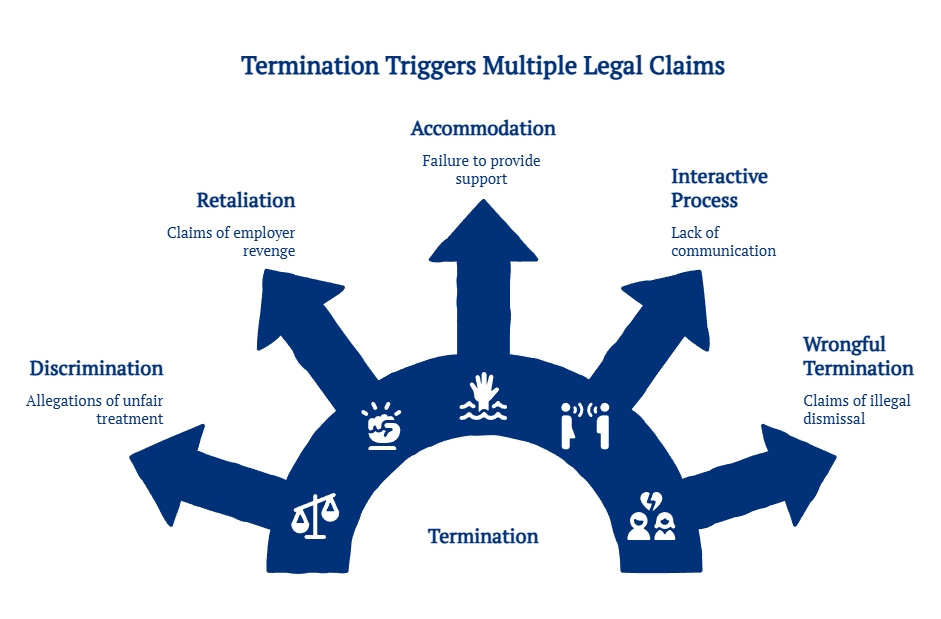
In a medical practice, one termination may occur against a fact pattern that includes staffing pressure, patient-coverage concerns, attendance issues, modified duties, disability-related work restrictions, or an employee’s request for job-protected medical leave. A plaintiff may use those facts to support several legal theories at once. The plaintiff may allege discrimination, retaliation, failure to accommodate, failure to engage in the interactive process, or wrongful termination based on the same sequence of events.
That pattern may appear more often in smaller practices because owners, administrators, supervisors, and office managers may participate directly in employment decisions. Communication may also be less formal than in larger organizations. Those facts do not establish liability. They may, however, give a plaintiff more opportunities to characterize the termination as part of a larger course of conduct, which may increase the scope of the dispute.
How a FEHA Claim May Expand the Scope of a Termination Dispute
When a plaintiff adds a FEHA discrimination claim to a wrongful termination claim, the case may extend beyond the question of whether the employer ended the employment relationship. The plaintiff may also challenge how the employer explained the decision, whether the explanation remained consistent, whether similarly situated employees received different treatment, and whether the employer’s stated reason was pretext for discrimination.
A FEHA-based case may also include related allegations involving disability, pregnancy, job-protected medical leave, reasonable accommodation, the interactive process, or failure to prevent discrimination. Where disability-related facts are present, related discussion appears in Wrongful Termination and Disability Discrimination Allegations in California Medical Practices: What Practice Owners Need to Know. For medical practice, the addition of FEHA allegations may widen the pleadings, expand the factual record at issue, and increase litigation burden.
Why Small Medical Practices May Face Closer Scrutiny of Decision-Making
Small medical practices often have fewer formal management layers, and owners or senior administrators may communicate directly with employees about attendance, scheduling, leave, performance, or discipline. In litigation, a plaintiff may point to those communications when attempting to show motive, causation, or pretext. However, under Senate Bill 303 (effective January 1, 2026), an employee’s acknowledgment of their own personal bias made in good faith during bias mitigation training cannot, by itself, be used as evidence of unlawful discrimination (Gov. Code, § 12940.2). This provides a narrow but important shield for practices that engage in proactive diversity and sensitivity training.
A plaintiff may also rely on emails, text messages, disciplinary write-ups, scheduling changes, or differing explanations given by management. Furthermore, under SB 513 (effective Jan 1, 2026), an employee’s ‘personnel records’ subject to inspection now explicitly include all education and training records, including certifications and the names of trainers (Lab. Code, § 1198.5). This allows a plaintiff to more easily scrutinize training materials.
Similarly situated employee comparisons may also become significant. A plaintiff may allege that another employee outside the protected characteristic received more favorable treatment under similar circumstances. For a small practice, direct owner involvement and informal communication patterns may therefore increase scrutiny of who made the decision, what reason the employer gave, and whether the record supports that explanation.
What Related Allegations May Appear Alongside Wrongful Termination and FEHA Discrimination
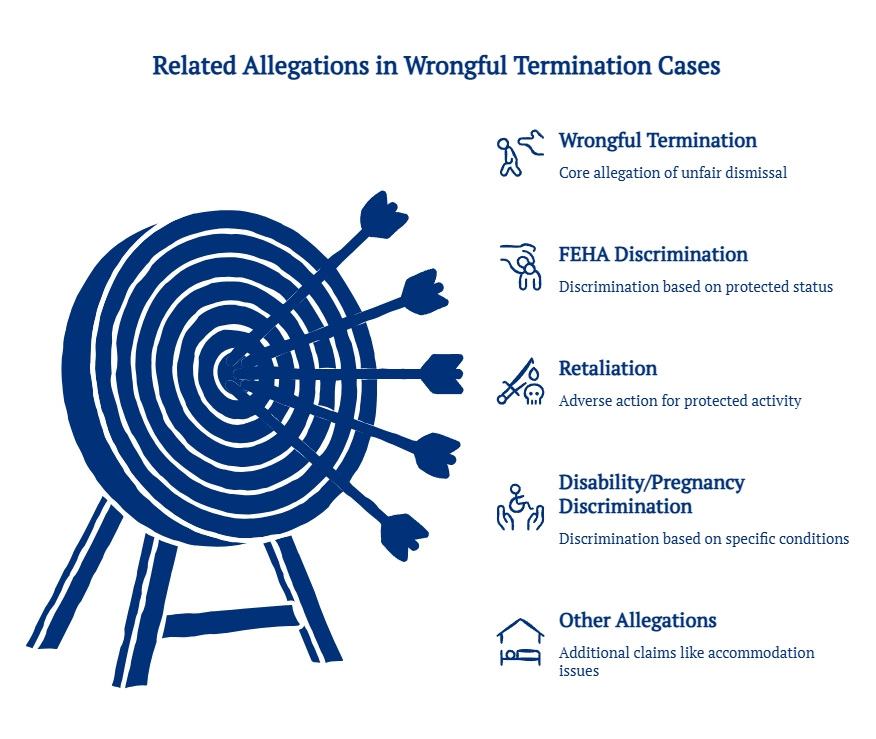
A plaintiff who challenges a termination may also plead related claims, including:
- retaliation based on protected activity;
- disability or pregnancy discrimination;
- unlawful ‘stay-or-pay’ or training repayment provisions (AB 692);
- failure to provide reasonable accommodation;
- failure to engage in the interactive process;
- interference with or retaliation related to job-protected medical leave; and
- whistleblower retaliation.
Those claims are legally distinct, but they often appear together when the plaintiff alleges that protected activity or protected status preceded the termination. For example, a plaintiff may allege that a request for reasonable accommodation was followed by disciplinary write-ups, reduced hours, or termination. A plaintiff may also allege that job-protected medical leave or protected reporting activity was followed by adverse employment action. Related reading includes Wrongful Termination and Retaliation Allegations in California Medical Practice Disputes: How They May Be Pleaded Together and whistleblower retaliation. When several claims appear together, the practice may face a more complex dispute than a single termination theory would present.
Why Distinction Matters to Employer Exposure
The distinction matters because the same discharge may support multiple theories of liability, each focused on a different legal problem. Wrongful termination may focus on whether the employer terminated employment for an unlawful reason. FEHA discrimination may focus more specifically on whether a protected characteristic motivated the decision. Retaliation, accommodation, interactive-process, leave, or whistleblower allegations may add still more issues.
For Southern California medical practices, that overlap may increase legal complexity, expand the factual allegations in the pleadings, and place greater pressure on management time and business operations. What begins as one termination decision may become a broader employment dispute involving several alleged statutory violations. From an employer-exposure perspective, that is why the distinction between wrongful termination and FEHA discrimination matters.
Disclaimer:
This content is for informational purposes only. Laws, definitions, and deadlines change. Verify current requirements through official California sources. This content is not legal advice. No attorney-client relationship is formed through this content. Please consult a qualified attorney in your jurisdiction for legal advice specific to your situation.
Protect Your Business | The Akopyan Law Firm, A.P.C. | Top Gun Employment Lawyers
Have you been sued by an employee? Are you overwhelmed by the complexities of employment law? If so, give us a call. The Akopyan Law Firm, A.P.C. assists small business owners throughout Southern California. Our seasoned employment defense lawyers stand ready to help employers quickly and efficiently resolve employment disputes. We are ready to aggressively and skillfully defend against any employment case, but understand that in most situations avoiding the expense of litigation is in the client’s best interest.
Take the First Step Protecting Your Future: Call us today to speak with one of our experienced employment lawyers.
Contact Us Today:
- Phone: (818) 509-9975
Office Locations in California: Los Angeles, Bakersfield, Costa Mesa, Temecula, Rancho Cucamonga, Oxnard, Culver City, and San Diego.