

📌 Key Takeaways
A California wrongful termination lawsuit against a medical practice often signals broader employer exposure than one termination decision alone.
- Termination Rarely Stands Alone: A termination claim may expand into allegations involving retaliation, discrimination, disability, reasonable accommodation, job-protected medical leave, or public policy.
- Medical Practices Create Dense Records: Emails, text messages, manager notes, scheduling changes, and disciplinary write-ups may increase scrutiny of motive, causation, and pretext.
- At-Will Language Has Limits: At-will employment may not defeat a claim when an employee alleges the termination was tied to protected activity or unlawful motivation.
- Timing Can Drive Exposure: A termination that follows protected activity, medical leave, or an accommodation request may become central to a retaliation or pretext theory.
- Operational Burden May Grow Quickly: Lost-pay allegations, emotional distress claims, attorney’s fees, and management disruption may turn one lawsuit into a broader business strain.
A termination dispute may become a larger credibility, causation, and documentation case.
Small medical practice owners, managers, and administrators facing employment disputes will gain immediate clarity here, guiding them into the medical-practice-specific details that follow.
~ ~ ~ ~ ~ ~ ~ ~ ~ ~ ~ ~ ~ ~ ~ ~ ~ ~
A wrongful termination lawsuit against a California medical practice often involves more than a dispute about one termination decision. In many cases, the employee alleges that the termination followed protected activity, reflected discrimination or retaliation, or arose from disputes involving disability, reasonable accommodation, the interactive process, job-protected medical leave, pregnancy-related issues, or California public policy. For a small medical practice, that kind of lawsuit may expand from a personnel dispute into a broader claim involving statutory exposure, evidentiary scrutiny, and operational strain.
Why a Medical Practice Termination Claim May Expand Beyond the Termination Itself
Under California law, generally, a wrongful termination claim may be pleaded alongside other causes of action rather than as a stand-alone theory. The employee may allege that the employer terminated employment after protected activity, after a request for reasonable accommodation, after a dispute about job-protected medical leave, or after conduct the employee characterizes as whistleblowing. When that happens, the lawsuit may place motive, causation, and pretext at the center of the dispute. The practical implication is clear: the case may turn less on the fact of termination alone and more on why the employer made that decision.
Why Medical Practices Often Generate Distinct Factual Narratives
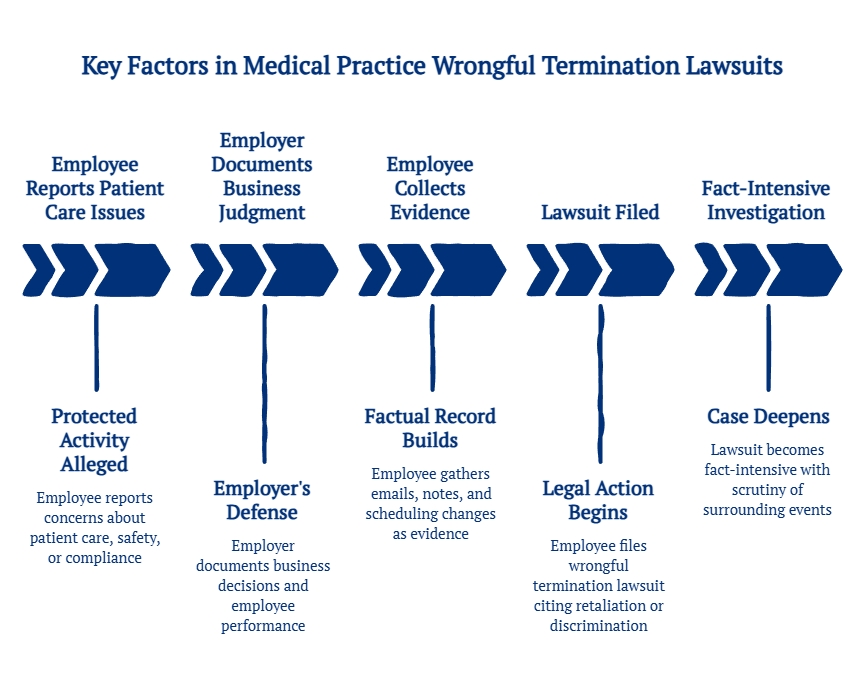
A medical practice often operates through close supervision, fast-moving staffing decisions, and frequent communication among physicians, managers, administrators, and staff. That setting may produce a factual record that is unusually dense. An employee may point to emails, text messages, manager notes, scheduling changes, disciplinary write-ups, or staffing discussions as evidence of retaliatory or discriminatory motivation. The employer may characterize the same record as evidence of legitimate business judgment.
The medical-practice setting may also shape the protected activity alleged in the complaint. An employee may allege that reports about patient care, workplace safety, sanitation, billing practices, staffing levels, or regulatory compliance constituted protected conduct. The employer may dispute that characterization, but the allegation itself may broaden the lawsuit and increase scrutiny of the surrounding facts. That is why a termination dispute in a medical practice may develop into a more fact-intensive case than the initial employment decision might suggest.
Why At-Will Employment May Not End the Legal Analysis
California employers often rely on at-will employment language, but at-will status may not defeat a claim where the employee alleges that the termination was motivated by retaliation, discrimination, protected activity, disability, job-protected medical leave, or public policy concerns. In many lawsuits, the central issue is not whether the employment relationship was at will in the abstract. The central issue is whether the employee alleges that the employer acted for an unlawful reason.
That is why a wrongful termination lawsuit may overlap with claims involving unlawful retaliation, whistleblower retaliation, disability discrimination, or reasonable accommodation. The legal consequence is significant: the employer’s stated reason for the termination may be examined against the employee’s allegations, the timing of events, and the documentary record.
Why Timing, Documentation, and Comparative Treatment May Become Central
Wrongful termination lawsuits often rely on circumstantial evidence. A judge or jury may be asked to decide whether the employer’s stated reason for the termination remained consistent across internal communications, personnel records, witness accounts, and subsequent litigation positions. For that reason, timing and documentation may become central to the case.
Several kinds of facts may draw particular attention:
- An employee may establish a rebuttable presumption of retaliation if an adverse action occurs within 90 days of their protected activity. Under SB 497 (Labor Code §§ 98.6, 1102.5, 1197.5), this proximity in timing effectively shifts the burden of proof to the employer to demonstrate a legitimate, non-retaliatory reason for the action. For medical practices, this means that any disciplinary action taken within three months of a complaint or leave request is legally viewed as ‘presumptively retaliatory’ unless the employer can produce clear evidence to the contrary.
- An employee may argue pretext where positive evaluations were followed by sudden performance criticism or where disciplinary records appear recent, inconsistent, or unevenly applied.
- An employer’s emails, text messages, and manager notes may be examined to determine whether they align with the stated reason for the termination.
- Comparator evidence may be offered to argue that another employee engaged in similar conduct but did not face the same adverse employment action.
For a small medical practice that scrutiny may extend well beyond the termination itself because owners, supervisors, and administrators often appear directly in the communications and decisions at issue.
Why Disability, Job-Protected Medical Leave, and Accommodation Issues Often Become Part of the Same Case
A wrongful termination lawsuit may also include allegations of disability discrimination, failure to provide reasonable accommodation, failure to engage in the interactive process in good faith, or retaliation connected to job-protected medical leave or pregnancy-related issues. In practical terms, the employee may allege that a termination followed medical restrictions, a leave-related absence, a return-to-work discussion, or a request for workplace adjustment related to a disability.
California laws, specifically the Fair Employment and Housing Act (FEHA), typically apply to medical practices with five or more employees, while federal statutes like the Americans with Disabilities Act (ADA) and Title VII generally require a threshold of 15 or more employees. [Gov. Code § 12926(d); 42 U.S.C. § 2000e(b)]. For the very smallest practices with fewer than five individuals, while certain discrimination claims may not attach, they may still face exposure under other theories of liability. That overlap may increase the number of legal theories in the complaint and may complicate the factual and legal analysis. The implication for the employer is that a termination occurring near disability-related discussions or medical leave status may be examined as part of a broader pattern rather than as an isolated event.
Why Whistleblower Allegations May Reshape the Lawsuit
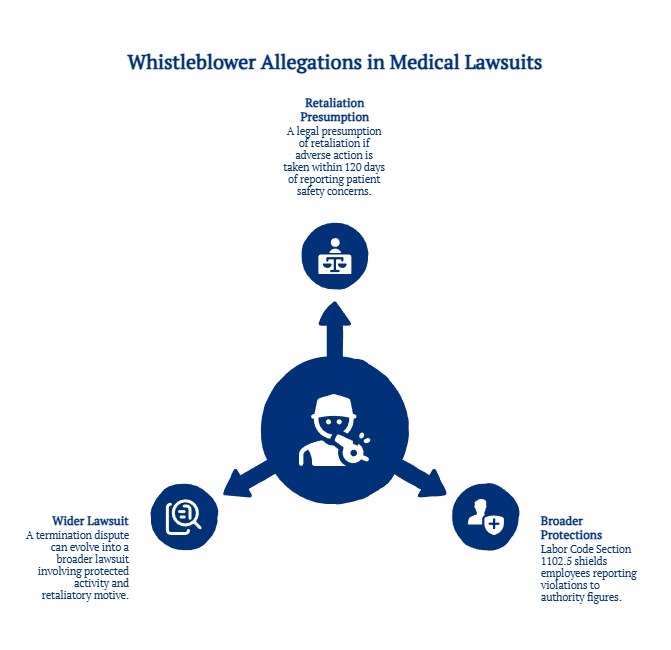
Whistleblower allegations in a medical setting are uniquely potent due to California Health & Safety Code Section 1278.5. This healthcare-specific statute creates a rebuttable presumption of retaliation if a practice takes adverse action against an employee within 120 days of them reporting concerns about patient safety or care quality. [Cal. Health & Saf. Code § 1278.5(d)(1)]. This exists alongside the broader protections of Labor Code Section 1102.5, which shields employees who report suspected violations of state or federal rules to a person with authority over them.
That broader claim pattern helps explain why related topics such as wrongful termination claims involving whistleblower allegations in medical practices and patient-safety narratives in Southern California medical practice disputes may arise from the same termination dispute. A complaint that begins with one termination decision may develop into a wider lawsuit centered on protected activity and alleged retaliatory motive.
What Employer Exposure May Include
Employer exposure in a California wrongful termination lawsuit is often driven by statutory fee-shifting provisions. Under FEHA, a prevailing plaintiff is generally entitled to recover their attorney’s fees, while a prevailing employer can typically only recover fees if they prove the case was frivolous—a high legal bar that creates significant ‘settlement pressure’ on the practice. [Gov. Code § 12965(c)]. Beyond fees, exposure may include back pay, front pay, and compensatory damages for emotional distress. In cases involving ‘oppression, fraud, or malice’ by a director, officer, or managing agent of the practice, punitive damages may also be awarded. [Cal. Civ. Code § 3294].
The broader point is that a wrongful termination lawsuit may place the employer’s decision-making, internal communications, and credibility under sustained examination. For that reason, these disputes often warrant prompt evaluation by a qualified employment defense lawyer familiar with California employment law.
Disclaimer:
This content is for informational purposes only. Laws, definitions, and deadlines change. Verify current requirements through official California sources. This content is not legal advice. No attorney-client relationship is formed through this content. Please consult a qualified attorney in your jurisdiction for legal advice specific to your situation.
Protect Your Business | The Akopyan Law Firm, A.P.C. | Top Gun Employment Lawyers
Have you been sued by an employee? Are you overwhelmed by the complexities of employment law? If so, give us a call. The Akopyan Law Firm, A.P.C. assists small business owners throughout Southern California. Our seasoned employment defense lawyers stand ready to help employers quickly and efficiently resolve employment disputes. We are ready to aggressively and skillfully defend against any employment case, but understand that in most situations avoiding the expense of litigation is in the client’s best interest.
Take the First Step Protecting Your Future: Call us today to speak with one of our experienced employment lawyers.
Contact Us Today:
- Phone: (818) 509-9975
Office Locations in California: Los Angeles, Bakersfield, Costa Mesa, Temecula, Rancho Cucamonga, Oxnard, Culver City, and San Diego.