
📌 Key Takeaways
Paired FEHA disability and termination allegations often turn one separation decision into a broader dispute about motivation, communications, and legal duties.
- Termination Anchors the Case: A complaint often treats termination as the central adverse employment action and uses it to frame timing, authority, and alleged inconsistencies.
- FEHA Theories Cluster: Pleadings commonly pair disability discrimination with reasonable accommodation, interactive process, and retaliation theories to cover distinct duties and disputed elements.
- Communications Become Evidence: Interactive process allegations often focus on who said what, when it was said, and whether engagement reflected good-faith consideration of feasibility.
- Healthcare Context Shapes Narrative: Complaints may emphasize patient-facing pace, coverage pressure, and confidentiality concerns to explain alleged motivation and perceived reasonableness of decisions.
- Disputes Turn Record-Driven: Parties often contest essential functions, notice to management, causal connection, and consistency narratives, making the factual record central to evaluation.
One termination event can become multiple legal theories when FEHA concepts, communications, and context are pleaded into a single narrative.
California medical practice owners and administrators facing active disputes will gain clearer issue-spotting perspective here, guiding them into the case-focused overview that follows.
~ ~ ~ ~ ~ ~ ~ ~ ~ ~ ~ ~ ~ ~ ~ ~ ~ ~
A California medical practice may receive a demand letter, administrative complaint, or lawsuit that pleads wrongful termination allegations alongside disability discrimination allegations. In many disputes, the pleading presents coordinated theories tied to the same alleged adverse employment action, with FEHA duties—specifically those enumerated under Government Code section 12940(a) (discrimination), 12940(m) (reasonable accommodation), and 12940(n) (interactive process)—that are used to frame alleged motivation, process failures, and inconsistencies in the employer’s stated rationale. [Source: Cal. Gov. Code § 12940]
Why these allegations are commonly pleaded together
Termination allegations tend to anchor a case because termination is a discrete employment event that can be pleaded around timing, communications, and decision-making authority. Once termination is framed as the focal event, the complaint may add disability-based allegations to contend that disability was a motivating factor, that the asserted reason was pretext, or that disability-related duties were not satisfied before the decision—depending on what is alleged and what the record later shows.
In smaller medical practices, the complaint may also characterize compressed management structures as relevant context. The complaint may allege that informal communications, rapid decisions, or limited administrative layers contributed to misunderstandings or inconsistent messaging, even when practice leadership views the same events as operational necessity.
The FEHA disability-related allegation cluster that often accompanies termination
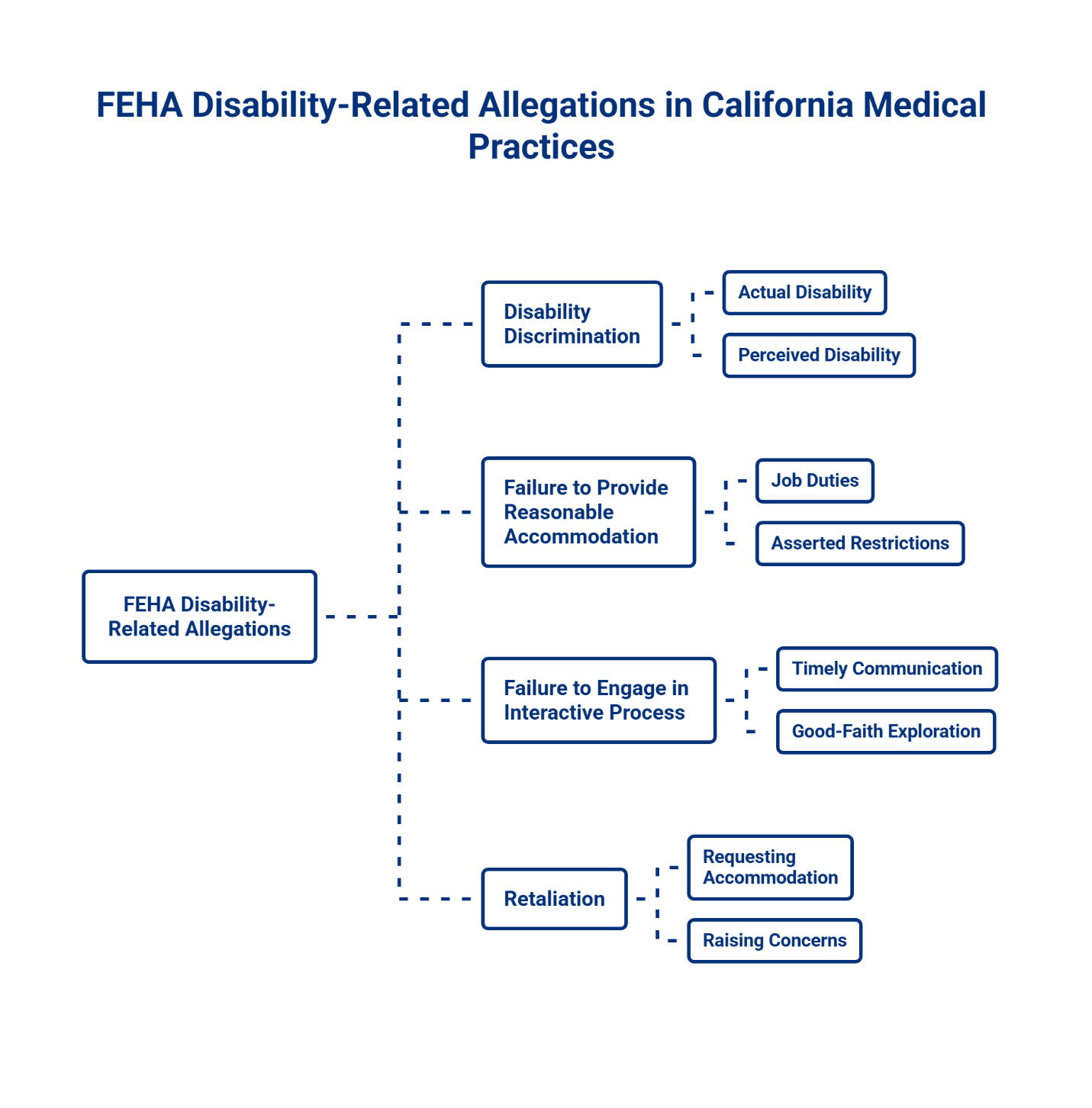
In California, disability-related allegations are commonly framed under the Fair Employment and Housing Act (FEHA). Complaints often plead multiple related theories because each theory corresponds to a distinct legal duty or element. While statutory subdivisions can matter in litigation, initial pleadings typically cluster concepts in a recognizable pattern.
Common allegation groupings include:
- Disability discrimination. The employee may allege that an actual or perceived disability was a motivating factor in an adverse employment action, including termination, depending on the alleged facts and asserted decision pathway.
- Failure to provide reasonable accommodation. The employee may claim that the practice did not provide a reasonable accommodation for a known disability, or ended employment without meaningfully assessing feasibility, depending on job duties and asserted restrictions.
- Failure to engage in the interactive process. The employee may allege that the practice did not engage in a timely, good-faith interactive process to explore accommodations, even where the practice disputes that an accommodation existed or that the employee was qualified.
- Retaliation. The employee may assert that requesting accommodation, raising disability-related concerns, or engaging in other protected activity under FEHA was followed by adverse employment action, with causation and motivation commonly disputed.
ADA concepts sometimes appear because they overlap in general structure (disability status, qualification, accommodation), but FEHA is usually the principal framework in California pleadings. This cluster matters because it often expands the dispute beyond the termination decision itself and into communications, feasibility, and competing narratives about motivation.
How complaints often frame interactive process allegations when termination is involved
Interactive process allegations center on whether the employer fulfilled its affirmative duty to engage in a timely, good-faith, interactive process to determine effective reasonable accommodations. While often focused on ongoing communications, California courts emphasize that this is a continuous obligation triggered as soon as the employer becomes aware of the need for accommodation. [Source: Wilson v. County of Orange (2009) 169 Cal.App.4th 1185]. The complaint may allege that the practice received medical information, observed work-related impacts, or heard a request for workplace changes. The complaint may then characterize the practice’s response as delayed, dismissive, or conditioned on outcomes the employee could not meet, depending on the alleged communications and who participated in them.
In the healthcare workplace context, the complaint often emphasizes coverage needs and high-demand roles. The complaint may allege that staffing constraints, patient-facing pace, or schedule rigidity displaced the required legal inquiry into whether the employee could perform essential functions with reasonable accommodation. This framing often becomes material in litigation because it places alleged communications and feasibility at the center of the parties’ competing accounts.
Why “wrongful discharge in violation of public policy” is frequently added
California termination pleadings often include wrongful discharge in violation of public policy as a companion claim. Commonly referred to as a Tameny claim, this theory allows an employee to sue for wrongful termination when the discharge violates a policy that is ‘fundamental,’ ‘substantial,’ and ‘public’ in nature. In disability cases, this claim is tethered to the public policy set forth in the FEHA itself, allowing plaintiffs to seek tort damages that might otherwise be capped or restricted under specific statutory schemes. [Source: Tameny v. Atlantic Richfield Co. (1980) 27 Cal.3d 167].
When disability-related allegations are pleaded, the public-policy framing often parallels policies against disability discrimination and in favor of protected workplace participation. The addition of the claim often tracks the same alleged events while potentially increasing the number of legal theories that must be evaluated and litigated.
Healthcare workplace themes that may shape allegations against medical practices
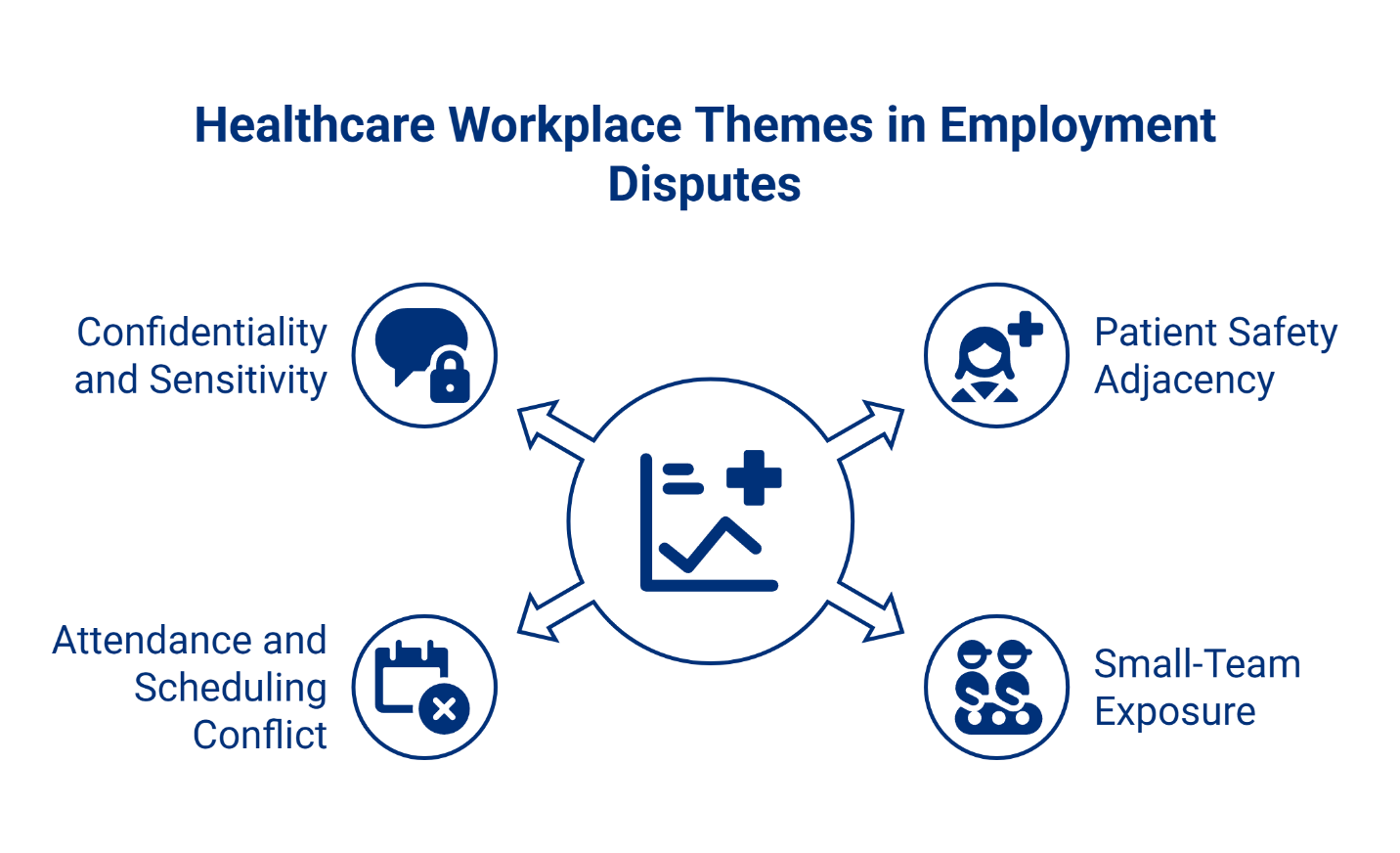
Medical practices operate under patient-care pressures and regulatory expectations, and a complaint may characterize those realities as amplifying the stakes of an employment dispute. Even when practice leadership views a decision as grounded in workflow, coverage, or role requirements, the complaint may describe the same events as stigma, impatience with disability-related needs, or intolerance for disruption.
Common themes that appear in allegations include:
- Patient safety adjacency. The complaint may allege that disability-related requests intersected with patient-facing responsibilities and that the practice treated the employee as a risk rather than evaluating the situation through lawful standards.
- Small-team exposure. The complaint may allege that a supervisor’s response effectively became the practice’s response because authority and communication were concentrated.
- Attendance and scheduling conflict. The complaint may assert that disability-related absences or schedule limitations were treated as performance deficiencies, even where the practice contends that reliability and coverage were essential.
- Confidentiality and sensitivity. The complaint may allege that disability-related information was discussed in a way that created stigma, depending on workplace communications.
These themes can influence how decision making is later interpreted because they shape the asserted context for motivation, reasonableness, and credibility.
Where retaliation is also pleaded, the dispute often becomes a contest over alleged motivation and causal connection rather than a debate over labels.
Commonly disputed issues in disability-related termination cases
These disputes are typically record-driven and fact-intensive. Even when both sides use the same legal terminology, disagreement often centers on what occurred, what was communicated, and what decisionmakers understood at the time.
Issues that are frequently contested include:
- Essential job functions. The parties may dispute what the job required in practice, especially in smaller settings where roles are blended and duties shift.
- Knowledge and notice. The parties may dispute what information reached management, when it reached management, and how communications to supervisors relate to organizational knowledge.
- Causation and motivation. The parties may dispute whether disability-related events were a motivating factor in the termination decision or whether the decision was driven by unrelated performance or operational concerns.
- Interactive process substance. The parties may dispute whether communications reflected good-faith engagement or a breakdown attributed to delay, misunderstanding, or refusal by one side.
- Consistency narratives. The parties may dispute whether similarly situated employees experienced different outcomes and whether factual differences explain the results.
For practice leadership, the strain can be significant: a decision made under real-time operational pressure may later be described in a pleading as unlawful motivation. That divergence commonly drives early disputes over documents, witnesses, and competing accounts.
Why early involvement of employer-side litigation counsel is often central in active disputes
Employment litigation and administrative matters can involve strict procedural deadlines, and a failure to respond may result in default judgment or sanctions; therefore, employers who receive any legal filing or agency notice should contact experienced employment defense attorney immediately.
Disclaimer:
This content is for informational purposes only. Laws, definitions, and deadlines change. Verify current requirements through official California sources. This content is not legal advice. No attorney-client relationship is formed through this content. Please consult a qualified attorney in your jurisdiction for legal advice specific to your situation.
Protect Your Business | The Akopyan Law Firm, A.P.C. | Top Gun Employment Lawyers
Have you been sued by an employee? Are you overwhelmed by the complexities of employment law? If so, give us a call. The Akopyan Law Firm, A.P.C. assists small business owners throughout Southern California. Our seasoned employment lawyers stand ready to help employers quickly and efficiently resolve employment disputes. We are ready to aggressively and skillfully defend against any employment case, but understand that in most situations avoiding the expense of litigation is in the client’s best interest.
Take the First Step Protecting Your Future: Call us today to speak with one of our experienced employment lawyers.
Contact Us Today:
- Phone: (818) 509-9975
Office Locations in California: Los Angeles, Bakersfield, Costa Mesa, Temecula, Rancho Cucamonga, Oxnard, Culver City, and San Diego.