
📌 Key Takeaways
Scheduling and call coverage disputes in California clinics often become wrongful termination allegations when pleadings connect timing, communications, and consistency to an asserted unlawful motive.
- Operational Decisions Reframed: A termination may be characterized as operational internally, yet a complaint may frame it as unlawful based on alleged motive.
- Timing Drives Allegations: A plaintiff may plead causal connection by placing protected activity or protected status close in time to termination.
- Consistency Becomes Evidence: A trier of fact may treat schedules, time records, and communications as a consistency check on the stated operational rationale.
- Mixed Motives Often Pleaded: A complaint may acknowledge staffing pressure while still alleging protected activity or protected status influenced the termination decision.
- Overlap Expands Narrative: Retaliation, FEHA discrimination, job-protected leave, and wage-and-hour allegations may be pleaded to add context to motive disputes.
Narrative coherence across records and testimony can shape how a clinic’s termination rationale is evaluated.
Southern California clinic owners, administrators, and operations leaders facing active employment disputes will gain clarity on how allegations are framed, preparing them for the detailed overview that follows.
~ ~ ~ ~ ~ ~ ~ ~ ~ ~ ~ ~ ~ ~ ~ ~ ~ ~
A termination in a Southern California medical clinic setting may be characterized internally as operational, yet framed very differently in a lawsuit, demand letter, or agency filing. A coverage gap can create urgency. A scheduling dispute can create conflict. A communication trail can create ambiguity. In California employment disputes, pleadings often connect those threads and allege wrongful termination by asserting an unlawful motive alongside an employer’s stated operational rationale.
Strict deadlines can apply to employment disputes and vary by claim and forum; employers should speak with an employment defense attorney about any time limits that may apply.
Why scheduling and call coverage conflicts in clinics often appear in termination claims
Clinical operations create recurring pressure points. Patient continuity creates coverage expectations. On-call models can distribute burdens unevenly. Last-minute absences can force rapid changes. Under those conditions, clinic leadership may make staffing decisions quickly, and those decisions may later become the center of an allegation narrative.
Clinics also often generate dense, time-stamped records. Scheduling platforms can preserve edits and sequence. Text threads can preserve tone. Email chains can preserve context. Timekeeping systems can preserve patterns. In many disputes, the trier of fact evaluates how timing, consistency, and credibility appear across those ordinary operational records, not whether one document settles everything.
Allegation narratives commonly asserted when scheduling conflicts precede termination
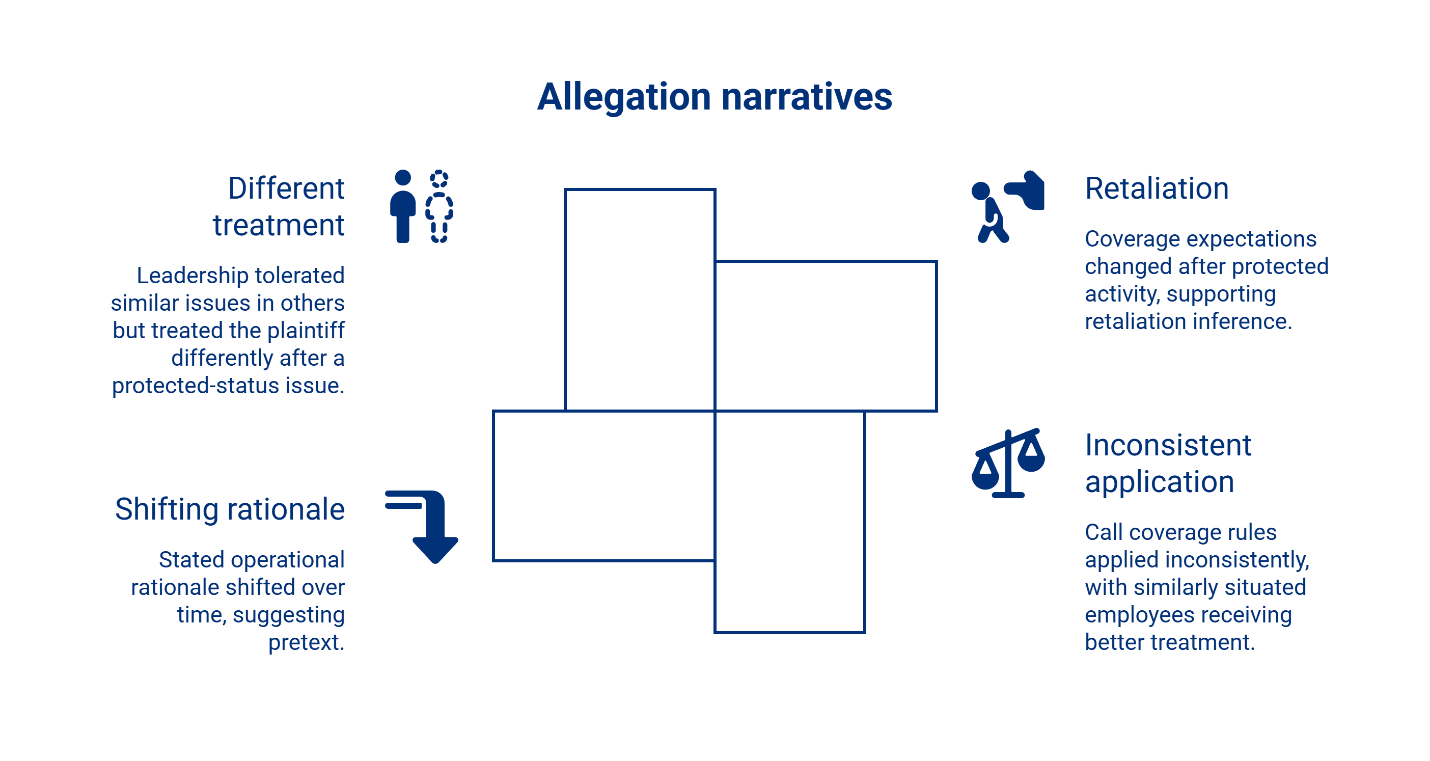
A scheduling disagreement can become a legal dispute through the narrative a complaint presents. Filings commonly use themes that fit recognized doctrines under California law, and they may reference overlapping federal concepts only where they align with pleaded theories.
Commonly alleged themes may include the following:
- The plaintiff alleges that coverage expectations changed after protected activity and contends that the timing supports an inference of retaliation.
- The complaint claims that call coverage rules were applied inconsistently and asserts that similarly situated employees received more favorable treatment.
- The employee asserts that the practice’s stated operational rationale shifted over time and contends that the shifts suggest pretext.
- The filing contends that leadership tolerated comparable scheduling issues by others and treated the plaintiff differently after a protected-status issue became salient.
The practical implication is that credibility disputes often attach to how the rationale is described and when it is described, not only to what the rationale is.
How mixed-motive framing may appear in clinic termination disputes
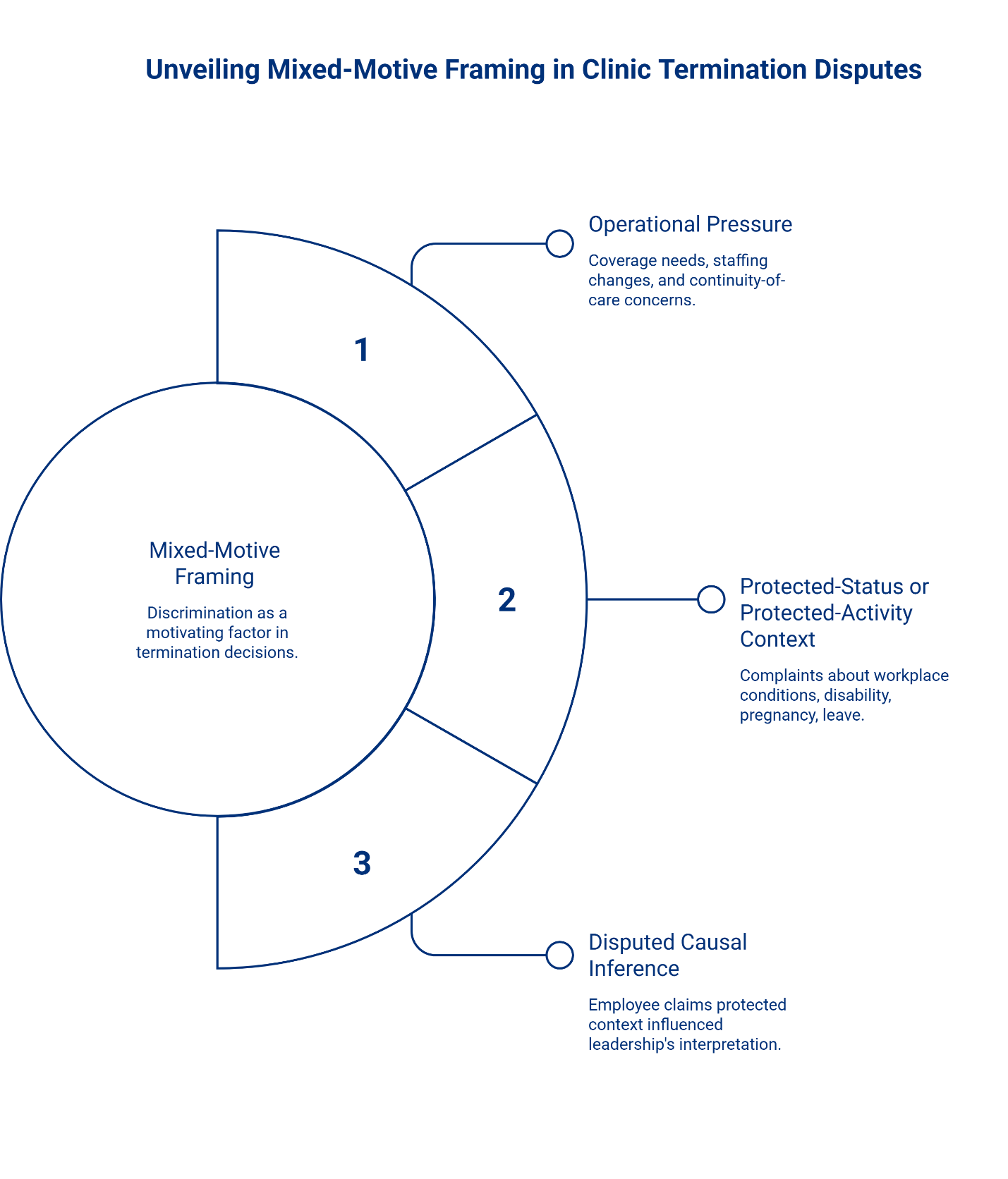
Mixed-motive issues frequently arise in California wrongful termination litigation, governed by the standard established in Harris v. City of Santa Monica (2013). Under this framework, if a plaintiff establishes that discrimination was a ‘substantial motivating factor’ in the termination, the employer may still avoid certain damages by proving it would have made the same decision anyway for legitimate operational reasons [Harris v. City of Santa Monica, 56 Cal. 4th 203].
In clinic settings, mixed-motive narratives often connect three elements:
- Operational pressure (coverage needs, on-call disputes, staffing changes, continuity-of-care concerns).
- A protected-status or protected-activity context (for example, a complaint about workplace conditions; a disability-related issue; pregnancy-related circumstances; job-protected leave; or reported compliance concerns).
- A disputed causal inference (the employee contends that the protected context affected how leadership interpreted later scheduling conflicts).
A complaint may allege that a termination followed a coverage dispute shortly after the employee raised concerns about workplace compliance, characterizing the sequence as retaliatory even where the practice points to reliability concerns. The takeaway is that timing is often pleaded as evidence of causal connection, even when the employer describes the decision as operational.
Operational records commonly scrutinized in scheduling-related termination disputes
Clinic disputes often concentrate scrutiny on routine business records. The dispute may focus on what those records show, what they omit, and whether expectations were applied consistently across employees.
Categories of material that may become central often include:
- Scheduling calendars, coverage rosters, and on-call assignment histories.
- Timekeeping records and attendance histories, particularly where coverage reliability is asserted as the key rationale.
- Business-record descriptions of role expectations, availability requirements, and coverage responsibility.
- Operational communications, including email, messaging platforms, and scheduling application notes.
- Communications describing staffing changes, patient-flow concerns, or continuity pressures that the practice contends drove decisions.
The “so what” is straightforward: the trier of fact may read these materials as a consistency check on the stated operational rationale, especially when messages or records appear to point in different directions.
Claim overlap often pleaded when termination is tied to scheduling or coverage disputes
Wrongful termination allegations in clinics are often pleaded alongside statutory claims used to add context. Overlap can change the scope of what gets argued, because pleadings may use multiple legal theories to support a single narrative about motive and causation.
A related claim may be retaliation, where the plaintiff alleges a causal connection between protected activity and the termination.
Another claim may be whistleblower retaliation, where the pleading ties scheduling friction to reported concerns about legal compliance.
Another related claim may involve discrimination under the California Fair Employment and Housing Act (FEHA), which provides broader protections than the federal Americans with Disabilities Act (ADA). While federal terminology like ‘essential functions’ is often referenced, California law specifically requires a standalone ‘interactive process’ to explore reasonable accommodations, and failure to engage in this process is an independent violation of state law [Cal. Gov. Code § 12940(n)].
Scheduling disputes are frequently framed as a failure by the clinic to accommodate medical restrictions and can intersect with disability-related issues, medical restrictions, or disputes over attendance and availability, and some pleadings also invoke the reasonable accommodation duty or the interactive process as part of the alleged context.
Additional claims may involve job-protected leave allegations, including CFRA/FMLA-adjacent narratives or pregnancy disability leave (PDL) protections, depending on the specific allegations.
Wage-and-hour allegations may be used to contextualize the termination narrative rather than to stand alone. Disputes may refer to overtime, meal and rest periods, or misclassification theories as part of a broader credibility argument.
Not every scheduling conflict raises these issues. Disputes that remain purely interpersonal, without alleged protected activity, protected status, or statutory framing, may present different considerations than the disputes described here.
Why clinic operations can create heightened credibility pressure in these cases
Clinics often make staffing decisions under patient-care constraints. Those constraints can be real and documented. Those constraints can also be difficult to visualize from a paper record. In that setting, a trier of fact may evaluate the employer’s explanation through the lens of fairness, predictability, and consistency.
Credibility pressure may intensify when:
- Leadership communications about coverage are read differently at different points in time.
- Informal messages convey frustration in a way that a trier of fact could interpret as personal rather than operational.
- Scheduling history reflects frequent exceptions for some employees and strict enforcement for one employee.
A complaint may allege that scheduling changes occurred around a disability-related issue and may frame the sequence as bias even where the practice cites coverage needs. The implication is not that the allegation is correct, but that clinic-specific pressures can be narrated in a way that puts credibility—rather than pure operations—at the center of the case.
What early stages of an employment dispute often emphasize
Early phases of an employment dispute commonly focus on defining issues, narrowing allegations, and identifying key categories of information. Initial litigation phases often center on:
- Pleadings and legal theories, where the complaint frames claims and the response frames defenses and denials.
- Information exchange, where schedules, communications, and time records may become focal categories.
- Witness testimony, where the dispute may center on who communicated what, when, and how coverage expectations were described.
- Resolution processes, including settlement conferences or mediation, may reflect operational pressures unique to clinical settings.
- The possibility of trial, where fact disputes can remain for a judge or jury to decide.
The takeaway is that early dispute activity often turns on narrative coherence across records and testimony, not on a single “policy” or a single event.
Why clinics often involve employment defense attorneys early in these disputes
Employment disputes at clinics can combine legal exposure with operational disruption, reputational sensitivity, and staffing instability. Defense attorneys can help minimize the risk of exposure, and efficiently resolve disputes where feasible.
Disclaimer:
This content is for informational purposes only. Laws, definitions, and deadlines change. Verify current requirements through official California sources. This content is not legal advice. No attorney-client relationship is formed through this content. Please consult a qualified attorney in your jurisdiction for legal advice specific to your situation.
Protect Your Business | The Akopyan Law Firm, A.P.C. | Top Gun Employment Lawyers
Have you been sued by an employee? Are you overwhelmed by the complexities of employment law? If so, give us a call. The Akopyan Law Firm, A.P.C. assists small business owners throughout Southern California. Our seasoned employment lawyers stand ready to help employers quickly and efficiently resolve employment disputes. We are ready to aggressively and skillfully defend against any employment case but understand that in most situations avoiding the expense of litigation is in the client’s best interest.
Take the First Step Protecting Your Future: Call us today to speak with one of our experienced employment lawyers.
Contact Us Today:
- Phone: (818) 509-9975
Office Locations in California: Los Angeles, Bakersfield, Costa Mesa, Temecula, Rancho Cucamonga, Oxnard, Culver City, and San Diego.