
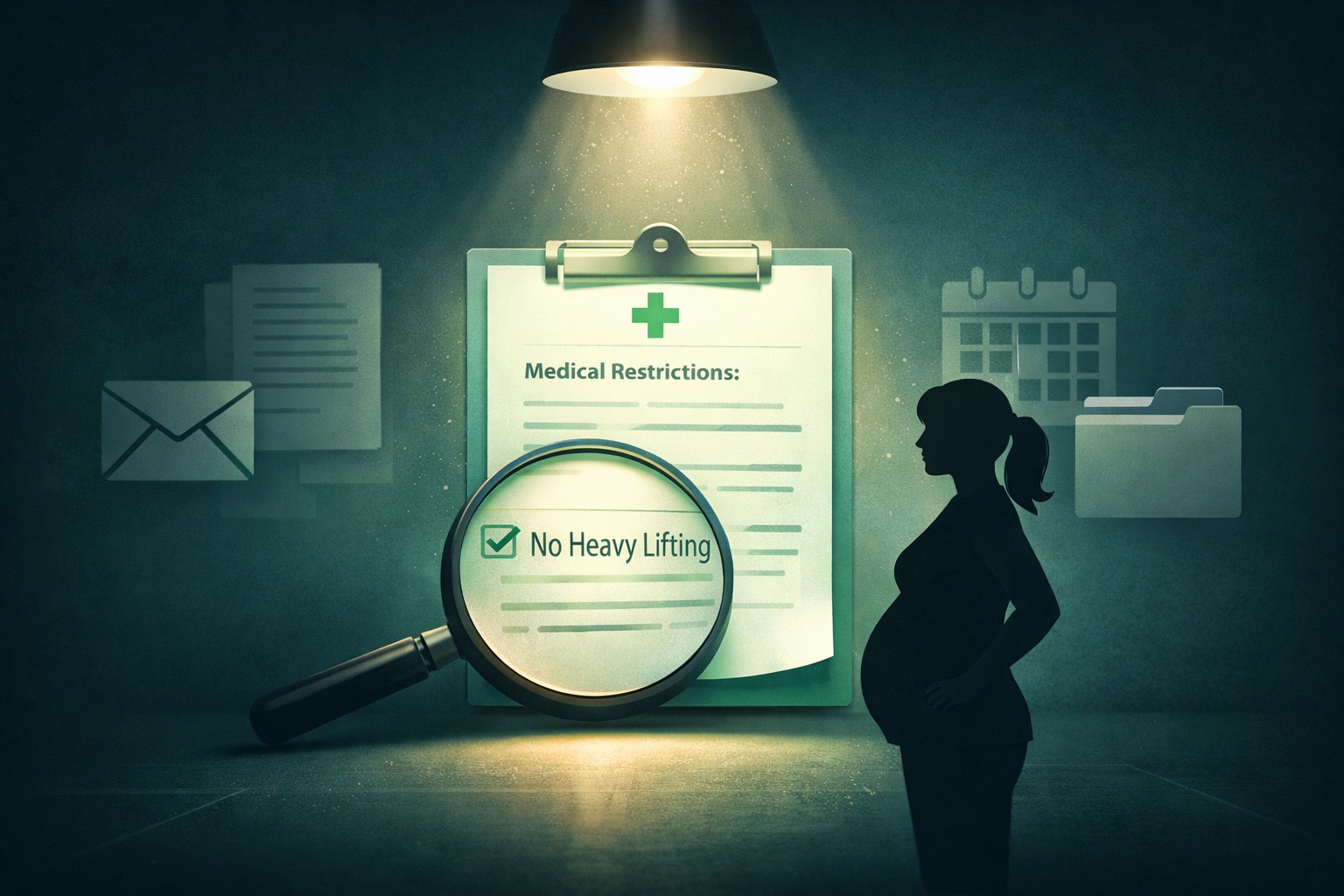
📌 Key Takeaways
- Workers in physically demanding California jobs may need a combination of pregnancy-related work restrictions, reasonable accommodation, temporary modified duty (sometimes called “light duty”), and job-protected Pregnancy Disability Leave (PDL) depending on medical guidance and job demands.
- Pregnancy Disability Leave (PDL) may provide job-protected leave when a pregnancy-related disability prevents the employee from performing essential functions safely, including after the employer evaluates reasonable accommodation through a good-faith interactive process.
- Documents such as policies, emails, schedules, and medical notes may help an employment attorney evaluate whether an employer’s response was consistent and legally compliant.
Clear medical restrictions, a documented interactive process, and consistent treatment of comparable work restrictions can help reduce legal risk and may allow employees to remain employed where feasible.
~ ~ ~ ~ ~ ~ ~ ~ ~ ~ ~ ~ ~ ~ ~ ~ ~ ~
For workers in physically demanding jobs in California—including warehouse, delivery, manufacturing, retail stockroom, and food-service roles—pregnancy-related work restrictions can raise practical and legal questions about reasonable accommodation, temporary modified duty, and job-protected leave. How an employer responds to medical restrictions and accommodation requests can affect job duties, leave decisions, and—in some cases—continued employment.
When Pregnancy-Related Medical Conditions May Trigger Disability Protections in Physically Demanding Jobs
Under California law, an employee may be “disabled by pregnancy” when a licensed health care provider identifies pregnancy, childbirth, or a related medical condition that limits the employee’s ability to perform job duties safely.
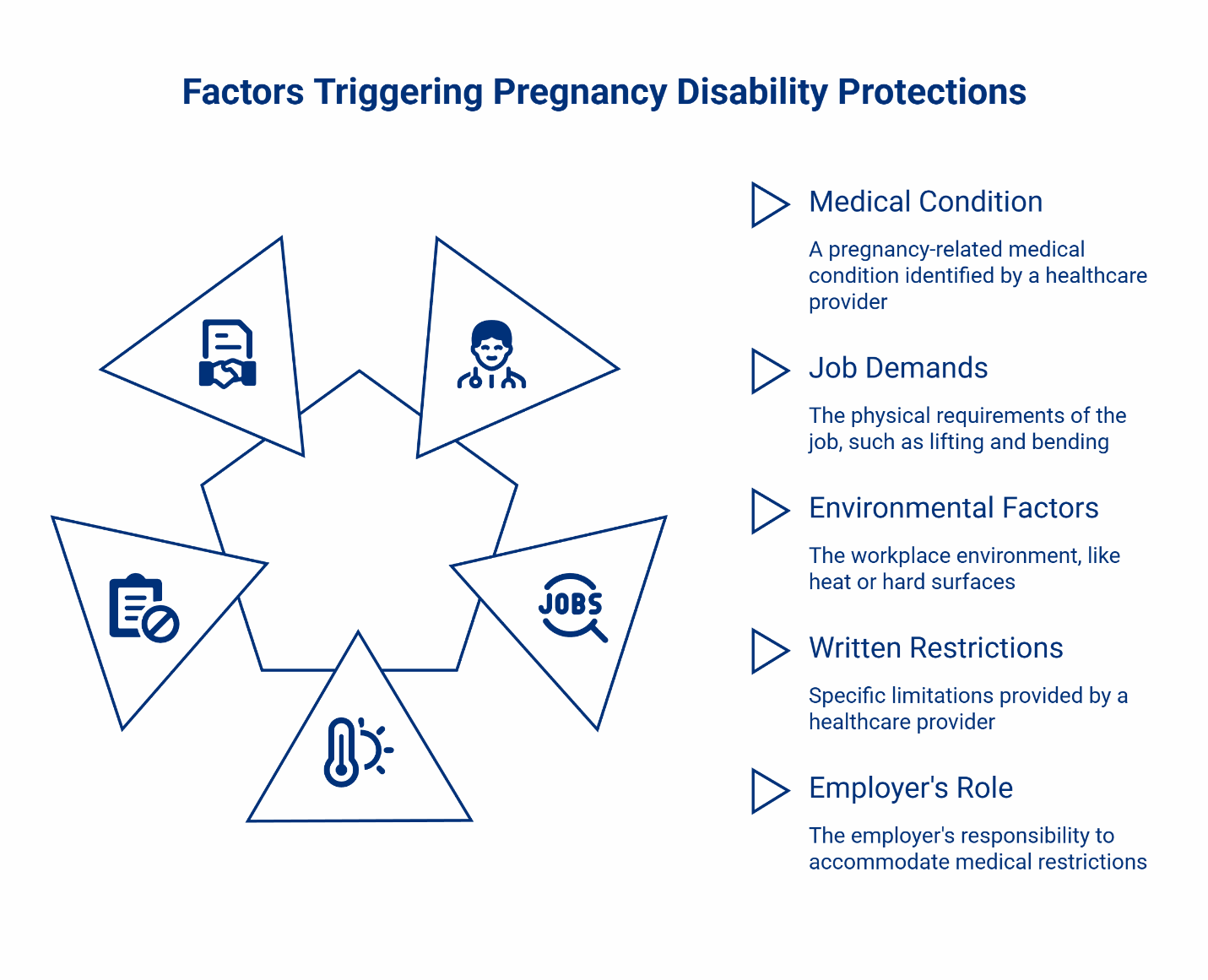
In physically demanding roles, that determination may occur earlier than in primarily sedentary work because the job may involve lifting, bending, climbing, constant movement, or exposure to challenging environments such as heat or long periods on hard surfaces.
For example:
- A warehouse worker may receive written restrictions limiting lifting over a certain weight or limiting prolonged standing.
- A retail stockroom worker or a back-of-house food-service worker may be advised to avoid overhead lifting, fast-paced repetitive motion, or extreme heat.
These restrictions reflect the health care provider’s clinical judgment. When an employee provides written restrictions, an employer generally may not substitute a supervisor’s personal view for medical restrictions when evaluating job duties and accommodation options. At that point, the employer may need to evaluate whether the employee can perform the job’s essential functions with reasonable accommodation.
Under California’s Pregnancy Disability Leave law, eligible employees may be entitled to up to four months of job-protected leave for pregnancy-related disability, depending on the circumstances.
When Pregnancy Disability Leave May Apply in Physically Demanding Jobs
Pregnancy Disability Leave (PDL) often becomes relevant when a pregnancy-related disability prevents an employee from performing essential functions safely, including where reasonable accommodation would not allow the employee to work safely in the current role. A health care provider may also recommend time away from work for pregnancy-related reasons.
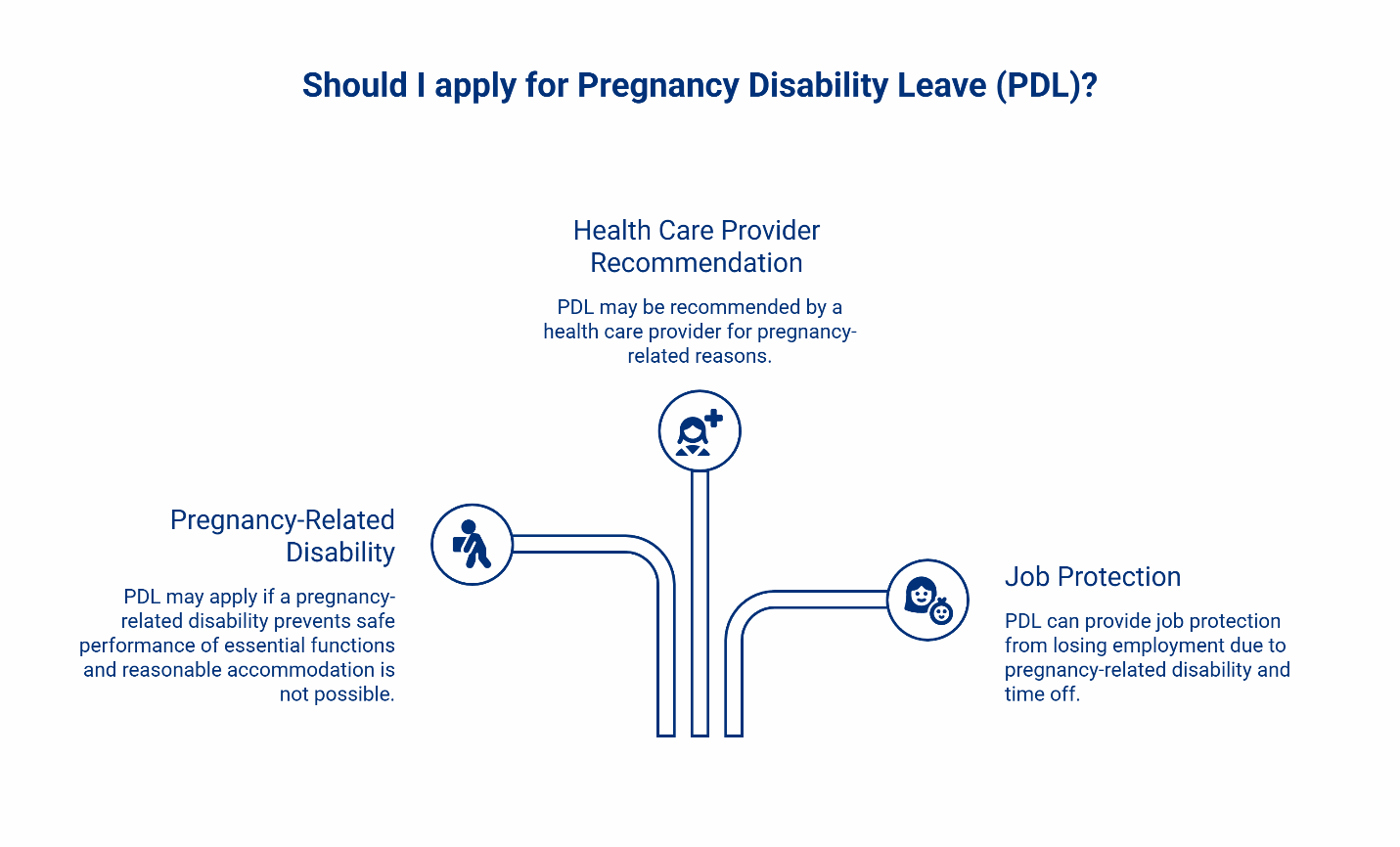
In physically demanding jobs, PDL may:
- Provide job-protected time away from strenuous tasks when restrictions cannot be reasonably accommodated in the current assignment.
- Help protect an employee from losing employment solely because of pregnancy-related disability and related time off, depending on the facts.
This discussion is intended to explain how PDL and accommodation questions commonly arise in strenuous workplaces, not to calculate leave for a particular individual.
Patterns That May Suggest Accommodation or Retaliation Concerns
Many employers make sincere efforts to comply with FEHA, PDL, and related laws. At the same time, certain recurring patterns in physically demanding workplaces may raise concerns about disability discrimination, failure to accommodate, retaliation, or wrongful termination under California law, depending on the evidence.
Examples of patterns that may warrant closer review include:
- A supervisor or HR representative states that “no light duty exists” without evaluating temporary reassignment options, even though the employer has reassigned other employees with comparable work restrictions to less strenuous tasks (such as scanning, dispatch, or inspection).
- The employee presents clear written pregnancy-related restrictions, but the employer continues assigning heavy lifting, prolonged standing, or fast-paced physical tasks without evaluating possible modifications.
- After the employee requests pregnancy-related reasonable accommodation or job-protected pregnancy disability leave, the employer issues new write-ups, reduces hours, changes schedules, or delivers negative reviews that appear inconsistent with prior evaluations or disciplinary history.
These patterns do not, by themselves, prove a legal violation. They may, however, support questions about compliance and whether the employer’s stated reasons for decisions are consistent with the record.
Hypothetical Examples
The following scenarios are hypothetical examples for illustration. They are not descriptions of real cases or predictions of outcomes, and they are not a substitute for advice about any individual situation. Each scenario illustrates how an employer’s response to pregnancy-related restrictions may be treated as evidence of failure to accommodate, failure to engage in the interactive process, retaliation, or pretext, depending on the full record.
- A pregnant warehouse worker provides a doctor’s note restricting heavy lifting and prolonged standing. The employer does not adjust duties, continues assigning the heaviest pallets, and refuses to discuss alternative tasks, even though other workers routinely perform scanning and packing work.
- A delivery driver requests a pregnancy-related accommodation—temporary assignment to routes with fewer stairs and lighter packages. Shortly afterward, the employer reduces her hours and then terminates her for “performance issues,” where similar issues were not documented before the accommodation request. This sequence may raise questions about whether the stated reason was pretext.
- A manufacturing worker with pregnancy-related complications is told no other duties are available, even though the employer has previously moved other workers with temporary restrictions into inspection roles while they recovered.
- A retail stockroom worker is told that once she cannot meet original lifting requirements, her only options are unpaid leave or resignation, and the employer declines to discuss modified duties. If an employer offers temporary modified duty to employees with similar work restrictions (including restrictions arising from injuries), refusing to consider comparable options for pregnancy-related restrictions may support an inference of unequal treatment, depending on the facts.
Depending on the full circumstances, a trier of fact could later be asked to evaluate whether the employer’s conduct reflected discrimination, failure to accommodate, failure to engage in the interactive process, retaliation, or another unlawful motive.
Workplace Information That Can Matter in Later Evaluation
If an employment attorney later evaluates an employer’s response to pregnancy-related work restrictions in a physically demanding job, certain categories of information often matter. These may include:
- Written policies, handbooks, or internal guidance describing how the employer handles accommodations, temporary modified duty, and pregnancy-related restrictions.
- Emails, text messages, or notes reflecting communications about pregnancy-related restrictions, job assignments, schedule changes, leave discussions, or return-to-work planning.
- Medical notes describing pregnancy-related limitations on lifting, standing, heat exposure, repetitive motion, or other physical demands.
- Schedules, assignment records, and similar documentation showing how the employer has handled other employees’ comparable work restrictions in the past.
- Performance reviews, disciplinary records, and documentation supporting any claimed performance-based rationale for adverse actions.
This information may help an attorney evaluate consistency, comparators, and the employer’s documentation of the interactive process, while recognizing that each situation is fact-specific.
Disclaimer:
This content is for informational purposes only. Laws, definitions, and deadlines change. Verify current requirements through official California sources. This content is not legal advice. No attorney-client relationship is formed through this content. Please consult a qualified attorney in your jurisdiction for legal advice specific to your situation
Protect Your Rights | The Akopyan Law Firm, A.P.C. | Top Gun Employment Lawyers
Have you been wrongfully terminated from your job? Have you suffered discrimination, harassment, or retaliation in the workplace? Has your employer violated wage and hour laws? If so, we can help. The Akopyan Law Firm, A.P.C. is dedicated to protecting and enforcing employees’ rights throughout Southern California. With a 97% success rate and millions recovered for our clients, our team of experienced and talented employment lawyers can fight to secure the justice you deserve.
Take the First Step Towards Securing Justice: Call us today to speak with one of our experienced employment lawyers. The firm offers case evaluations free of charge.
Contact Us Today:
- Phone: (818) 509-9975
- Office Locations: Los Angeles, Bakersfield, Costa Mesa, Temecula, Rancho Cucamonga, Oxnard, Culver City, and San Diego in California.
Important: Contacting the Akopyan Law Firm, A.P.C. does not create an attorney-client relationship, but all communications will remain private and confidential. Each case is unique. The Akopyan Law Firm, A.P.C., does not guarantee any outcome.